


Where change happens: Embedding sustainability in academic programs (part 1)
Higher education institutions are increasingly expected to integrate sustainability into teaching and prepare graduates to address complex environmental and societal challenges. This is a transition we aim to support at Sulitest.
Our recent research project explored how sustainability moves from institutional strategy to operational implementation within academic programs. Through more than twenty interviews with program directors, deans, sustainability directors and more, we examined the governance dynamics that shape how sustainability is embedded in curricula.
This article is the first article in a three-part blog series sharing the key findings and recommendations.
Understanding where change happens
When we want to drive meaningful change in a system, we must first understand where to intervene. As systems thinker Donella Meadows highlighted, not all intervention points are equally effective—some have far greater transformative potential than others.
Academic program design and review operate through a multi-layered governance process that combines strategic decision-making, regulatory compliance, pedagogical implementation, market feedback, and epistemic adaptation. Rather than following a linear path, programs evolve through successive cycles of negotiation and adaptation involving multiple actors.
Institutional leadership—such as deans and executive teams—and academic governance actors—including program directors, academic leads, and faculty committees—interact through formal mechanisms such as curriculum review boards and pedagogical committees. Beyond these, a wider ecosystem of stakeholders—students, alumni, employers, accreditation bodies, and external partners—also plays an important role in shaping programs.
As a result, academic programs are often not shaped by a single decision-making body, but by a distributed governance system.
This system exists between institutional and regulatory frameworks that define both constraints and opportunities. While such frameworks impose compliance requirements—including auditing, reporting, and evidence of learning outcomes—they can also serve as catalysts for innovation. In line with Meadows’ perspective, when the “rules of the game” evolve—for example through accreditation standards or national frameworks that value sustainability—the entire system begins to shift.
How academic programs are transformed
Our research identifies five interrelated phases through which sustainability—and other emerging priorities—is integrated into academic programs.
- Strategic decision-making phase: Program direction and positioning are shaped by the institution’s broader strategy. They often reflect broader shifts in the higher education landscape and the growing institutionalization of sustainability. This phase plays a crucial role in legitimizing sustainability and embedding it within institutional priorities.
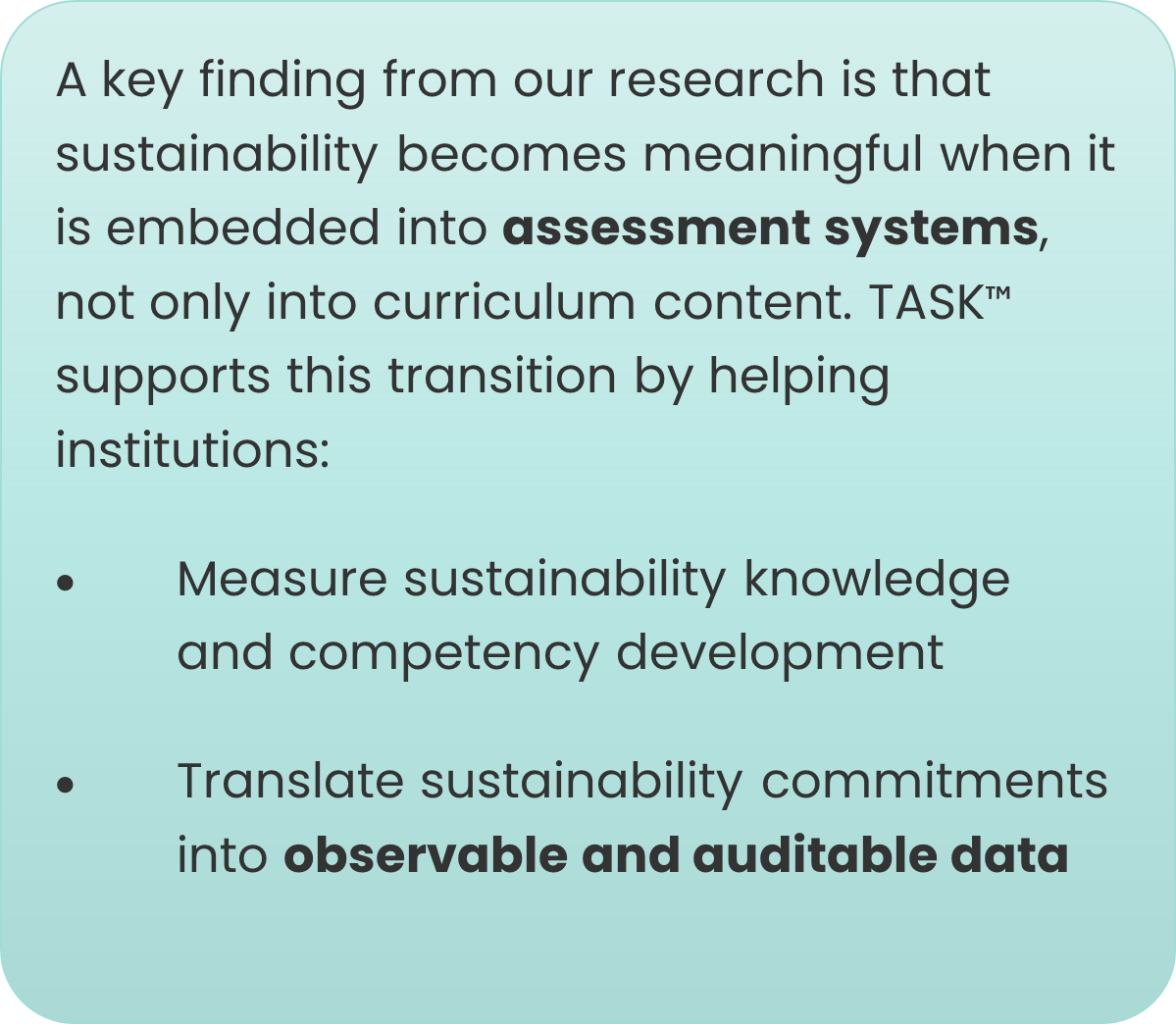
- Normative and compliance phase: Regulatory frameworks play a dual role. They can create administrative burden and inertia, but also provide strong leverage by turning sustainability from a symbolic commitment into an operational teaching objective. Importantly, interviewees emphasized that sustainability only becomes meaningful when it is embedded in assessment systems.
- Market and corporate phase : Input from employers, industry partners, internship supervisors, and alumni helps identify evolving competency needs and ensures alignment with external expectations—effectively “closing the loop” between education and practice.
- Epistemic and innovation phase : Scientific developments, societal debates, and regulatory transformations continuously reshape understandings of sustainability. Academic programs must reconcile competing demands—from employers, institutional priorities, disciplinary traditions, and student expectations— making curriculum development an ongoing process of knowledge negotiation.
- Pedagogical and operational phase: At this stage, curriculum transformations become operational through syllabus revisions, the creation of new modules, and the integration of sustainability within existing courses. Faculty play a central role here, highlighting the need for strong “translation mechanisms” to ensure a shared understanding of sustainability and adequate support.
Navigating tensions in the system
These phases continuously interact and often create tension. For example,
- Labor markets often prioritize short-term employability and clearly defined professional competencies, whereas sustainability challenges require longer-term systemic thinking and transformative capabilities.
- Accreditation systems require standardized competency frameworks and auditable learning outcomes, which may constrain experimental or interdisciplinary approaches to sustainability education.
This is why effective curriculum governance is essential.
Integrating sustainability into academic programs is less a question of adding new content than of how leadership and governance bodies organize curricular change.
Meaningful curriculum transformation occurs when institutional strategy, governance coordination, and pedagogical implementation are aligned. Without this alignment, sustainability initiatives tend to remain fragmented or isolated.
Recommendations
Based on these findings, three recommendations emerge:
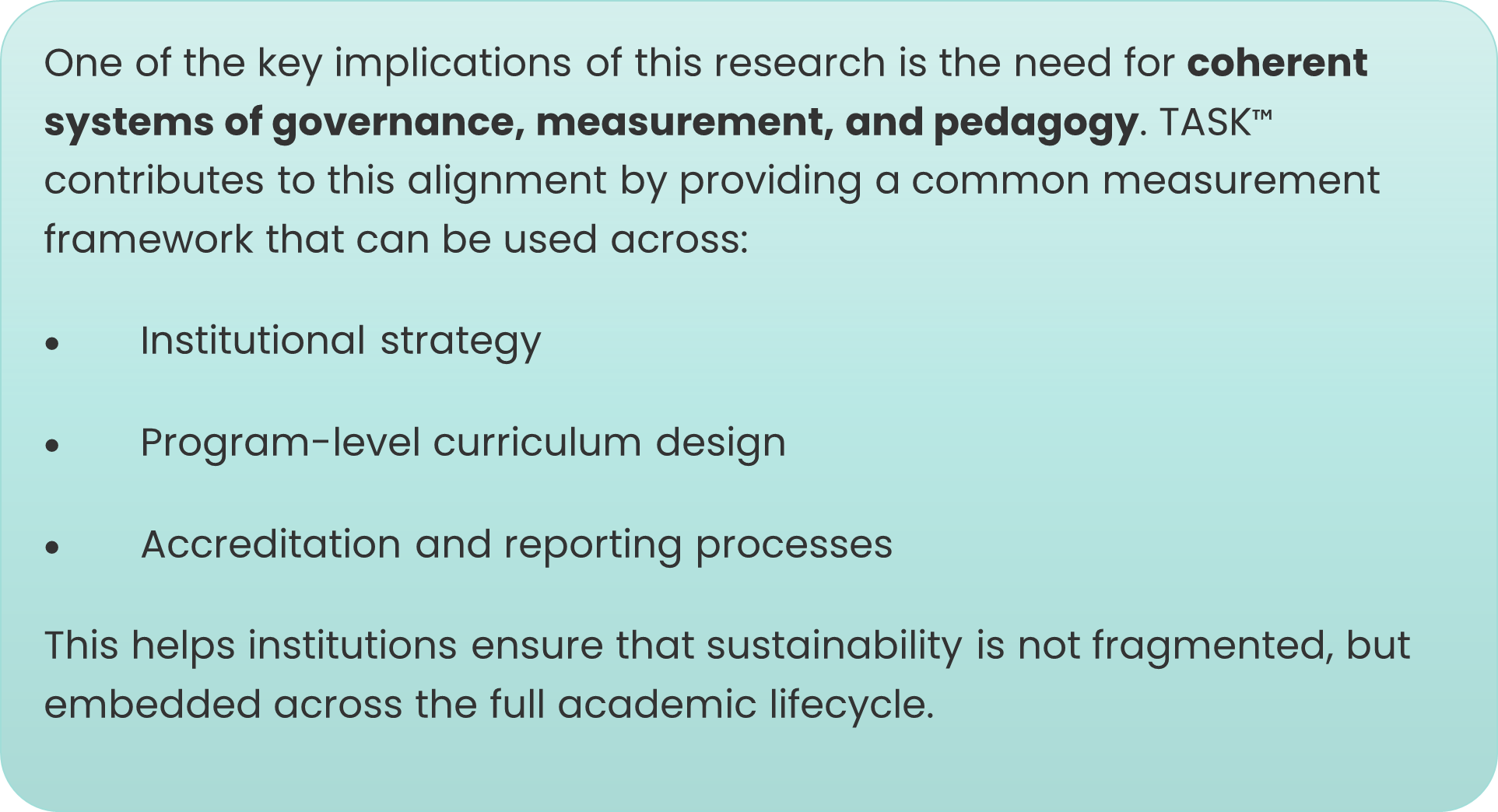
- Use frameworks strategically rather than administratively, translating competency standards into operational pedagogical tools.
- Strengthen governance coordination between strategic leadership, program directors, and faculty members to ensure coherent curriculum implementation.
- Move beyond isolated sustainability courses toward integrated curriculum approaches combining horizontal and vertical integration.
Stay tuned
In part two, we will explore which the role of institutional and regulatory frameworks and create a typology of institutional approaches to sustainability integration. In part three, we explore barriers and levers for sustainability education, providing more recommendations for institutions strengthening curricular sustainability integration.
Download the full report
This article only highlights a selection of insights from our research.
The full white paper, How to Transform Higher Education Institutions: The Role of Strategic Leadership and Academic Governance, explores these dynamics in greater depth. It includes detailed interview findings, a full mapping of governance mechanisms, and practical implications for institutional leaders, program directors, and sustainability teams.

Our latest articles
Stay in the loop!
Are you interested in sustainability education, the latest news from our movement, or key events in the sector?
