


Driving systemic change in sustainability education: Sulitest at the 2026 UN HLPF
Each year, Sulitest contributes to the United Nations High-Level Political Forum by sharing evidence on the state of sustainability knowledge in higher education and convening conversations about what it will take to accelerate progress.
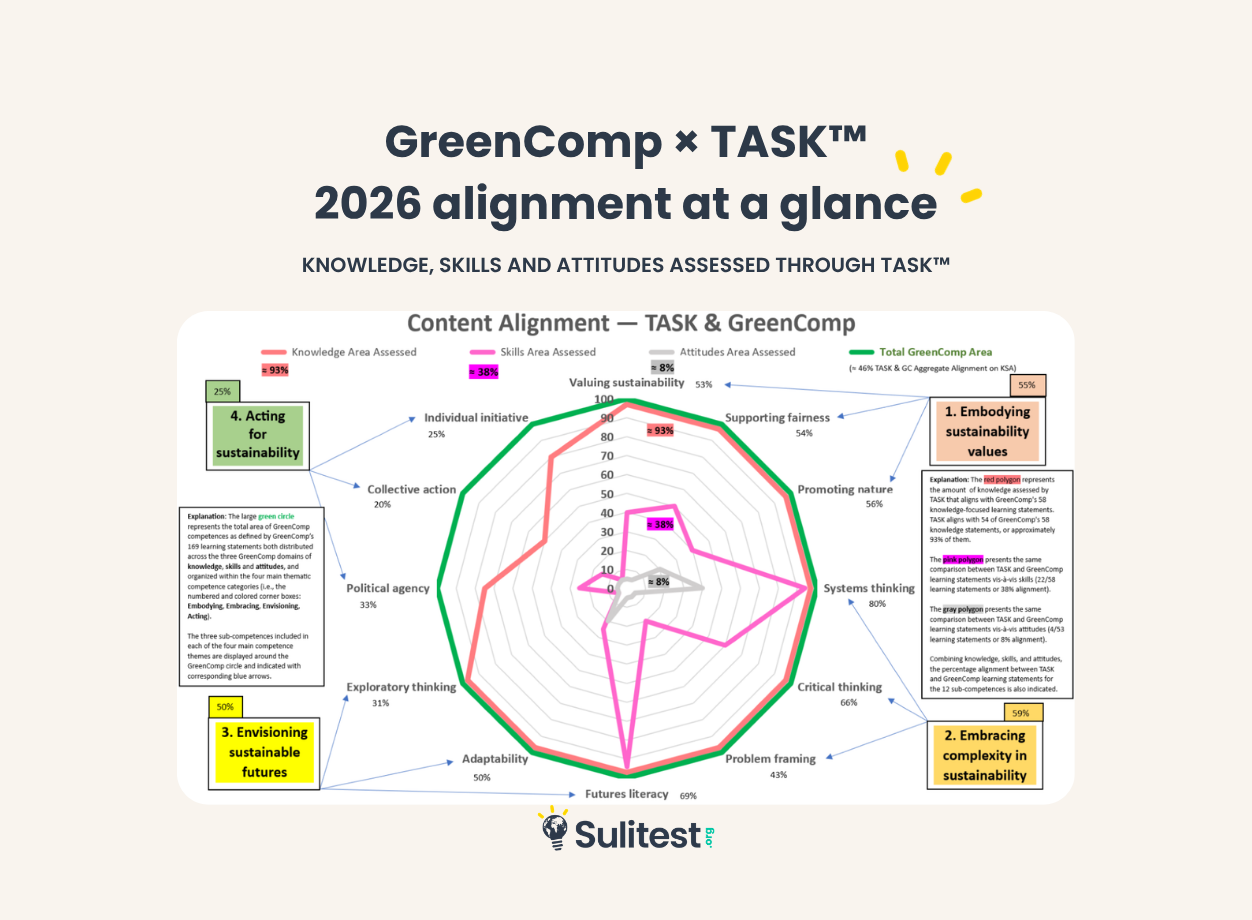
At our 2026 event, Driving systemic change in sustainability education: Scaling coordinated action for the SDGs, Scott G. Blair, PhD, Content Development Editor at Sulitest, presented key trends from the latest Sulitest report and the scale of the work ahead: sustainability knowledge remains unevenly distributed, with particularly important gaps in systems thinking, environmental interdependencies and the levers available to drive transformation. You can explore the report findings in a dedicated blog here.
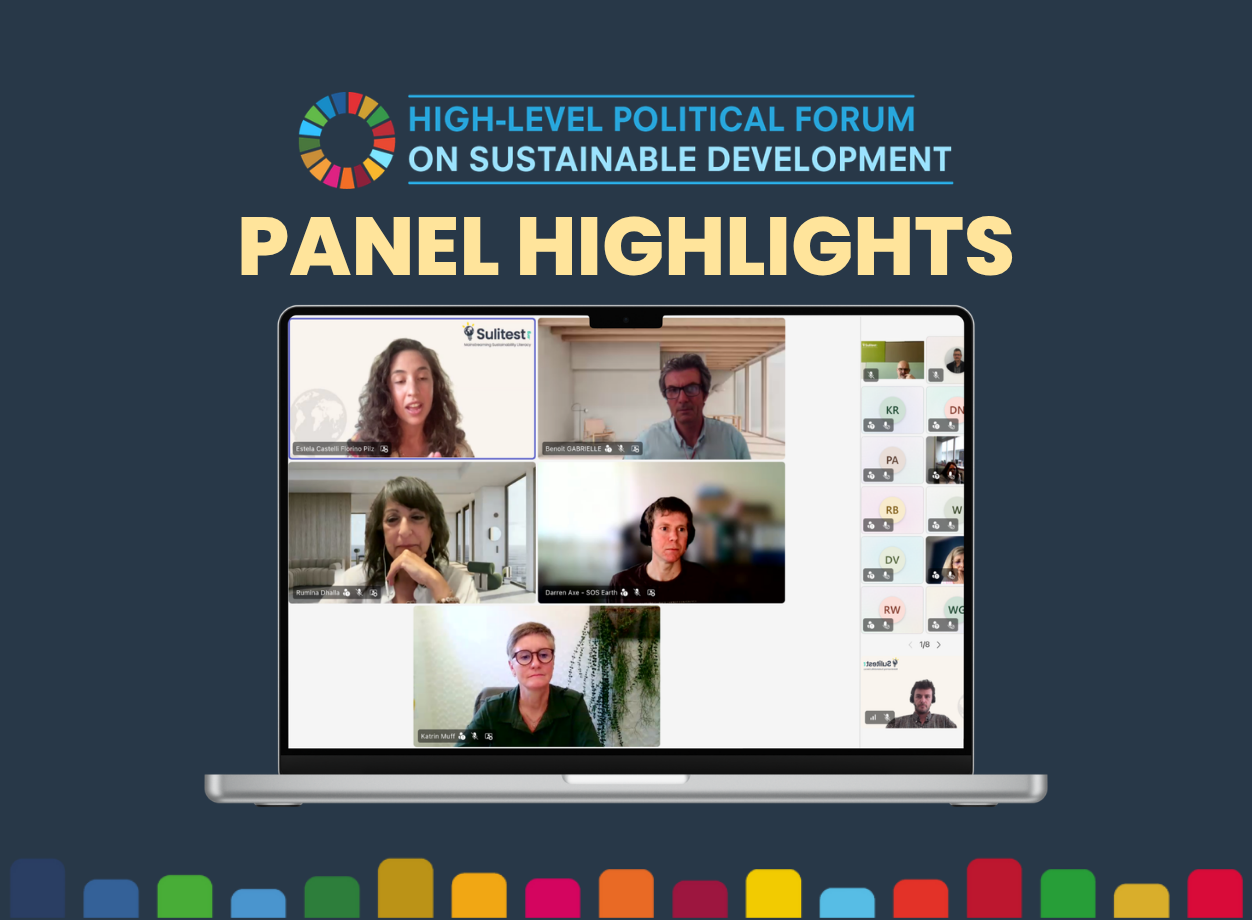
The second part of the event moved from understanding to action. Moderated by Estela Castelli Florino Pilz, Account Manager at Sulitest, the panel brought together four perspectives on institutional strategy, faculty development, student engagement, assessment and responsible management education. The conversation explored three interconnected questions: how sustainability education can be embedded, incentivised and scaled.

Meet the panellists
- Benoit Gabrielle, Professor of Bioeconomy and Sustainability Science and Vice-President for Sustainable Development and Societal Responsibility at Université Paris-Saclay.
- Darren Axe, Membership and Engagement Manager at Students Organising for Sustainability International.
- Katrin Muff, President of the Positive Impact Rating, which assesses the societal impact of business schools.
- Rumina Dhalla, Associate Professor at the Gordon S. Lang School of Business and Economics at the University of Guelph.
Embedded: making sustainability part of every learning journey
Benoit shared the experience of Université Paris-Saclay, where thousands of undergraduate students from disciplines ranging from law to medicine complete an introductory sustainability course, as part of a national requirement. While this provides an important common starting point, it risks remaining too general. Paris-Saclay is therefore working with faculties to connect sustainability more explicitly to students’ future professions and to introduce cross-cutting foundational modules. The message was clear: a common baseline matters, but it must be followed by disciplinary translation.
That translation depends heavily on faculty. Rumina emphasised the importance of professional development, accessible teaching resources, interdisciplinary collaboration and enabling institutional structures.
Darren added that interdisciplinary learning becomes especially powerful when it moves beyond theory. "Only one third of student learning happens inside the core curriculum. Two thirds happen from co-curricular or subliminal curricular components of any given institution." Collaborative projects, simulations and action labs can bring students from different fields together to address shared challenges. Locally grounded curricula can also connect learning to the cultural and natural heritage of a region, Indigenous and traditional knowledge, community organisations and real-world sustainability initiatives.
Assessment also has an important role to play. Katrin described societal impact as extending across institutional culture and governance, educational content and pedagogy, research, student support and public engagement. Measuring these dimensions can help institutions move beyond isolated examples and understand whether sustainability is truly becoming part of the organisation.
Incentivised: aligning recognition with institutional ambition
Even highly committed faculty operate within systems that determine how time, resources and professional success are allocated. Benoit shared several practical approaches. At Université Paris-Saclay, faculty can receive reduced teaching duties to redesign courses, develop sustainability modules or undertake training. He also argued that sustainability should become part of recruitment, promotion, performance reviews and academic job descriptions. However, he acknowledged that such schemes often remain limited in scale.
Rumina noted that many educators are already motivated by personal commitment. “Sustainability is a core academic responsibility,” she stated. Incentives should therefore remove barriers rather than create new reporting burdens. Time, funding, professional development and recognition are often more valuable than symbolic rewards.
Katrin brought a complementary perspective from rankings, ratings and accreditation. External frameworks can create valuable pressure and give institutional leaders leverage to advance change. At the same time, reporting can encourage superficial compliance when institutions focus on demonstrating activity rather than transforming education.
Keeping this work meaningful requires listening to those who experience the institution directly. It requires creating space and ensure that the voices of students and community partners are heard and valued. Darren also highlighted the value of investing in student-led initiatives. Although student organisations are often under-resourced, even modest increases in funding and capacity can deliver substantial returns through transformational learning, stronger student engagement, community impact and institutional reputation.
Incentives are therefore not only financial. They also include:
- time and workload recognition;
- access to training and pedagogical resources;
- funding for interdisciplinary experimentation;
- visibility for faculty and student initiatives;
- inclusion in recruitment, evaluation and promotion;
- credible assessment and stakeholder feedback;
- accreditation and ranking criteria that reward outcomes rather than declarations.
The challenge is to ensure that these mechanisms support genuine educational change instead of only producing a better-written sustainability report.
Scaled: moving from individual initiatives to systemic change
Many universities already have strong sustainability courses, committed educators and student-led initiatives. The challenge is moving from isolated examples to institution-wide transformation.
Katrin stressed the need to close the gap between institutional commitments and what happens in practice. Assessment can help by making progress visible, identifying implementation gaps and bringing student and faculty perspectives into decision-making.
The panel returned to the importance of participation. Students should not be treated only as recipients of sustainability education. Darren’s examples of student–staff co-created Green Offices illustrated how students can contribute to governance, curriculum development, practical projects, campus operations and community engagement. When students are given responsibility, infrastructure and meaningful access to decision-making, their energy can become a driver of institutional transformation.
Rumina argued that sustainability must become part of an institution’s core identity rather than remain a specialist programme or temporary initiative. Scaling occurs when sustainability is understood as a shared academic responsibility across disciplines—and when institutional resources support the people already advancing this work. One way towards sustainable transformation would be to shift the focus from identifying incentives to enabling.
Benoit argued that scaling sustainability education also means moving from awareness-raising to action-oriented teaching. Since sustainability engages complex science, personal values and social norms, active learning methods such as flipped classrooms, role play, and moving debates can help students engage with real-world complexity. At Université Paris-Saclay, an undergraduate sustainability course is being redesigned as a gamified experience. This kind of transformational learning also requires faculty support, including training that equips educators to use these methods confidently.
Scaling does not mean imposing one universal model. Estela closed the panel by emphasising that transformation will look different in every institution. Approaches must remain locally relevant, responsive to communities and attentive to institutional context. What can be shared is not a single blueprint, but a set of enabling conditions: leadership, faculty capacity, student agency, coordinated governance, credible assessment and structures that turn feedback into action.
From sustainability awareness to systemic change
The discussion showed that sustainability education is a process of institutional change.
It must be embedded across disciplines and learning journeys. It must be supported by incentives that recognise the work required of faculty, students and staff. And it must be scaled through coordinated governance, partnerships, measurement and shared responsibility. The task is no longer only to raise awareness, but to create education that equips learners to understand systems, collaborate across boundaries and act.
The panel therefore left participants with a practical question:
What will you do to make sustainability more deeply embedded, meaningfully incentivised and effectively scaled in your institution?
The event recording can be found here.

Our latest articles

Stay in the loop!
Are you interested in sustainability education, the latest news from our movement, or key events in the sector?
