


From aspirational commitments to measurable learning: What AACSB AoL means for sustainability education
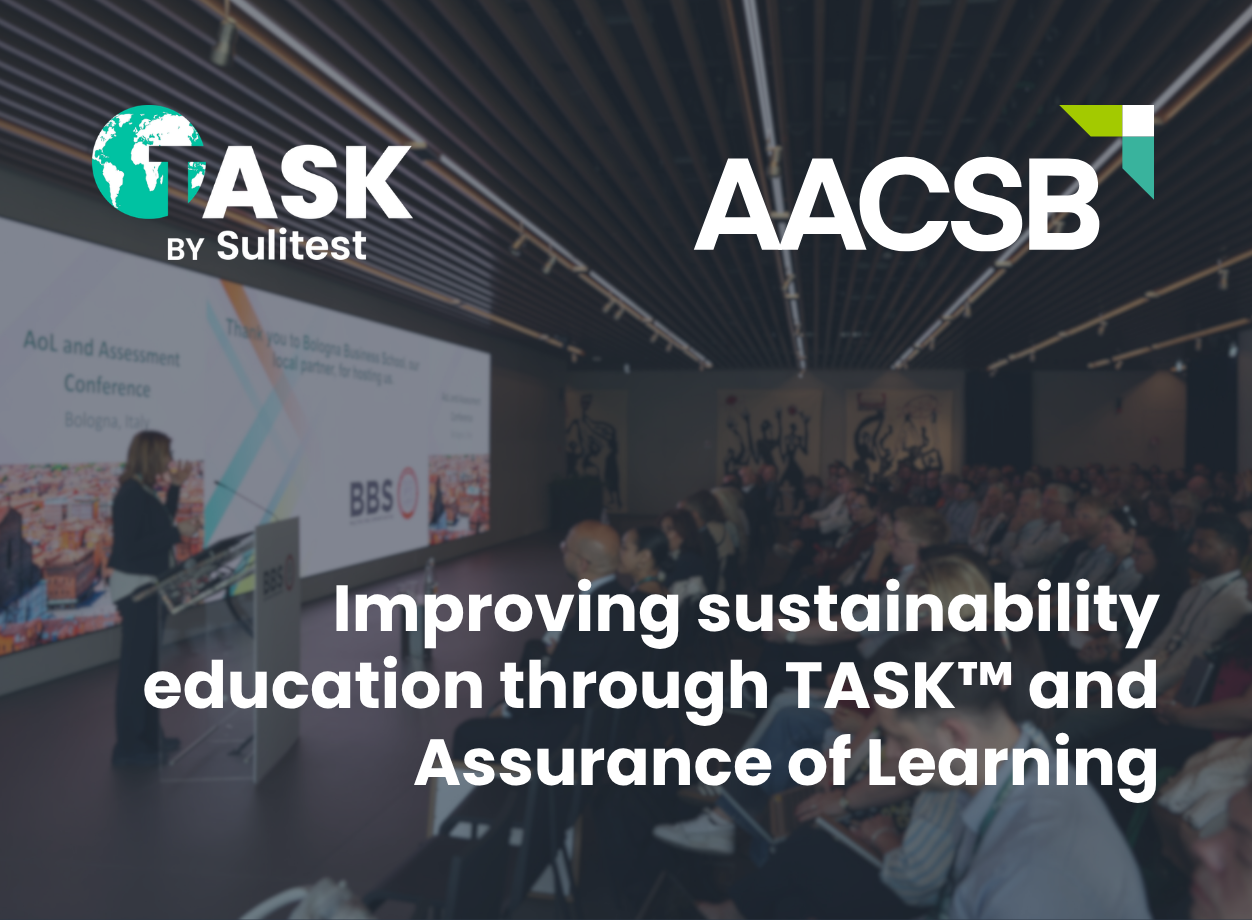
At this year’s AACSB AoL conference in Bologna, we hosted a session titled “How AoL Can Move Sustainability from Aspirational Commitment to Embedded Curriculum Practice.
Together with partners from Leuphana School of Management and Technology and Onsi Sawiris School of Business, the discussion explored a question many business schools are currently facing:
How do we move sustainability from a strategic commitment into something that is consistently embedded, experienced, and evidenced across programs?
Sustainability education is not just a curriculum question
One of the key themes emerging from both our session and our ongoing research is that sustainability integration is rarely just about adding content to courses.
It is an organizational process involving:
- curriculum design and revision,
- faculty engagement,
- leadership priorities,
- quality assurance structures,
- and shared definitions of what sustainability competencies actually mean.
Frameworks and accreditation standards can sometimes feel restrictive because they require documentation, evidence, and compliance. But they can also create important institutional levers for change
AACSB AoL: More than compliance
AACSB’s heartbeat is “assess once, identify the problem, make intentional changes, measure again, close the loop.” This process sounds straightforward in theory, but in practice, it is one of the most difficult aspects of accreditation work.
For sustainability education this matters because everyone claims to teach it. Yet few define it clearly and even fewer measure it systematically. In this context, AoL can provide structure and a shared language to make sustainability learning visible.
Common AoL challenges business schools face
1. Defining sustainability competencies
We are witnessing a significant shift in language across business education — from “Responsible Management Education” toward broader concepts of “Sustainability.”
This shift matters because sustainability expands the scope of what institutions are expected to prepare students for. Without shared competency definitions, assessment becomes fragmented and difficult to compare. Institutions increasingly need:
- a common language,
- measurable competency frameworks,
- and consistent assessment approaches across programs.
This is one reason schools are adopting shared assessment tools such as TASK.
2. Connecting sustainability and accreditation work
Many sustainability initiatives already exist across institutions, but AoL and accreditation teams often struggle to gather clear evidence of impact. The challenge is not always the absence of activity — it is the absence of structured, comparable data. Shared tools help bridge that gap by creating consistent evidence that can support:
- curriculum reviews,
- accreditation reporting,
- program discussions,
- and continuous improvement processes.
3. Managing assessment data at scale
AACSB’s Standard 5 increasingly emphasises structured assessment reporting and evidence collection, as seen in the new Table 5-1 (see below). For institutions managing multiple programs, data collection can quickly become overwhelming.
This is where shared measures become valuable. Rather than relying exclusively on disconnected course-level assessments, tools like TASK can provide:
- institution-wide competency data,
- comparable program signals,
- longitudinal insights,
- and a shared basis for curriculum conversations.
Case studies from the TASK community
Both institutions participating in our session use TASK, but in different ways.
At Leuphana, TASK was integrated across programs through collaboration between program directors and the quality assurance office. The assessment process helped create institution-wide discussions around sustainability competencies, particularly in disciplines where sustainability had previously been less visible, such as engineering and information systems.
At Onsi Sawiris School of Business, TASK was embedded into a mandatory student development program linked to employability and career preparation. While positioned outside the formal curriculum (not in a course per se, although required for students to attend), the assessment is supporting a growing student interest in sustainability. Importantly, employer feedback reinforced the relevance of sustainability competencies. Even when sustainability knowledge was not immediately applicable to entry-level roles, employers recognized its importance in preparing graduates for future organizational and societal challenges.
In both cases, TASK acted not simply as an assessment instrument, but as:
- a shared institutional language,
- a conversation starter,
- and a practical mechanism for embedding sustainability into AoL processes.
How TASK supports AACSB AoL
Assessment tools alone do not create meaningful AoL systems. But they can help institutions operationalize them.
Within an AoL framework, TASK can help institutions:
- Surface program-level signals: Identify patterns in student sustainability competencies across programs, cohorts, or disciplines.
- Support curriculum decisions: Use evidence to inform curriculum review, revision, and faculty discussions.
- Inform learner support: Understand where students may need additional development or scaffolding.
- Connect to competency goals: Align sustainability assessment with broader institutional learning objectives and accreditation frameworks.
Most importantly, it helps transform sustainability from a broad institutional aspiration into something measurable and actionable. Because ultimately, institutions cannot improve what they cannot meaningfully observe.
AoL as a lever for sustainability education
AoL should not be treated purely as an accreditation requirement. AACSB increasingly frames Standard 5 as an opportunity for schools to demonstrate what makes their institution distinctive and mission-driven, rather than simply compliant.
For sustainability education, this is particularly important. The question is not simply: “Do we teach sustainability?”
But rather:
- What kind of sustainability competencies matter for your institution?
- How are they intentionally developed?
- How do you know whether students are actually achieving them?
- And how does that evidence inform continuous improvement?
These are ultimately strategic questions about educational purpose, institutional identity, and graduate preparedness.
Example: AACSB Table 5-1 using TASK
Below is a simplified example of how TASK could appear within an AACSB Standard 5 AoL new reporting structure.
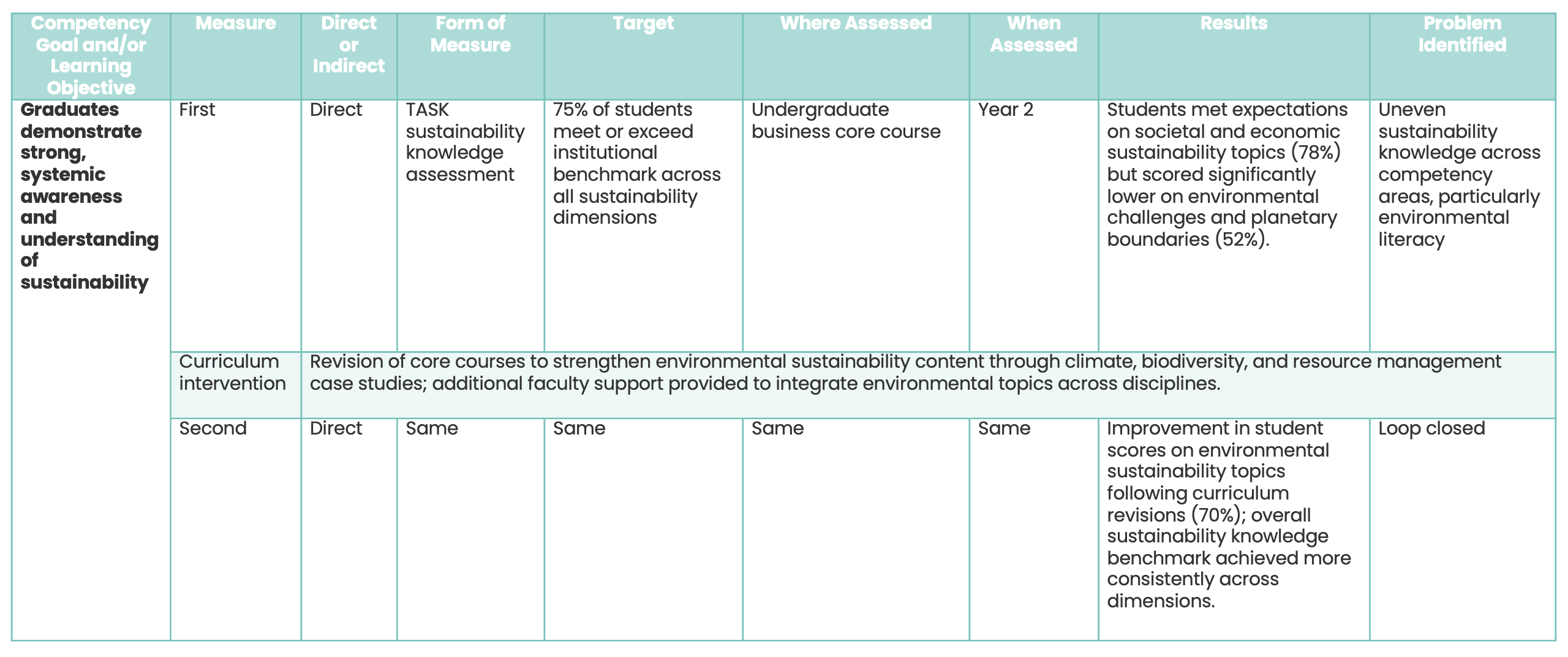
This is, of course, simplified. But it illustrates the broader principle behind AoL: assessment evidence should lead to intentional curricular improvement.
As sustainability becomes increasingly embedded within accreditation standards, institutions are being asked not only to demonstrate commitment, but also to evidence learning. This is where AoL can become a powerful strategic tool rather than simply a reporting exercise.
By helping institutions measure sustainability knowledge consistently, surface curriculum gaps, and support continuous improvement, TASK contributes to making sustainability education more visible, actionable, and meaningful across programs. If your institution is currently exploring AACSB AoL processes, sustainability competency assessment, or curriculum mapping initiatives, we would be happy to continue the conversation.

Our latest articles

Stay in the loop!
Are you interested in sustainability education, the latest news from our movement, or key events in the sector?
