


Aligning Sulitest TASK™ with SEAC Sustainability Education Guidelines

How TASK™ and the Change Leader program provide data-based evidence that helps you demonstrate compliance with accreditation standards and quality assurance
Scott Blair, Ph.D., Sulitest Content Development Editor
TASK™ — A Tool with Multiple Uses and Applications
Sulitest TASK™–The Assessment of Sustainability Knowledge does more than you might think when it comes to providing your accreditation agency with evidence showing compliance with their accreditation and quality assurance standards. While it’s natural to think that TASK™ helps you report only on basic assessment processes around sustainability—e.g., documenting student learning, demonstrating increasing achievement of programmatic goals, or measuring societal impact—the data TASK™ generates, and the transformative experience it provides, helps you report across numerous standards of good practice beyond assessment and evaluation, such as institutional leadership, vision and mission, curricular and co-curricular programming, campus and institutional culture, faculty professional development, student support, and much else.
Indeed, what’s great about using TASK™ is just how much it helps institutions document their complementary initiatives in innovation, leadership, social responsibility, community engagement, and student employability, to mention just a few. So, while Sulitest TASK™ doesn’t do everything for you, and while becoming a Change Leader won’t—alone—get you re-accredited, it will make your life easier when accreditation cycles come around, and when you start documenting good practice in quality assurance and standards compliance at your institution. Read on to learn how!
SEAC — The New Accreditation Agency on the Block … for Sustainability Education!
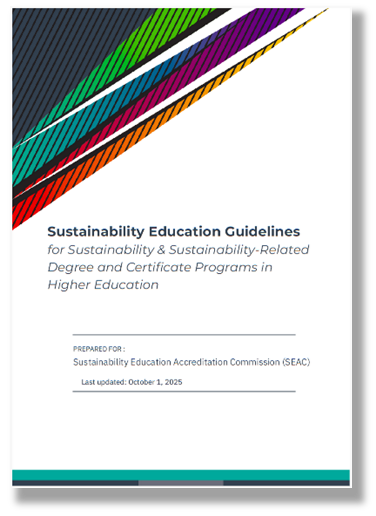
Let’s take the example of the very new accrediting body called SEAC—Sustainability Education Accreditation Commission—which you’ll recall from a previous blog, just became a valued partner with Sulitest in advancing quality sustainability education.
The mission of SEAC is primarily achieved via SEAC’s Sustainability Education Guidelines which provide a comprehensive framework for accreditation standards in higher education. They represent the first widely available synthesis of practice standards, and they are designed to support and improve sustainability-related degree and certificate programs.
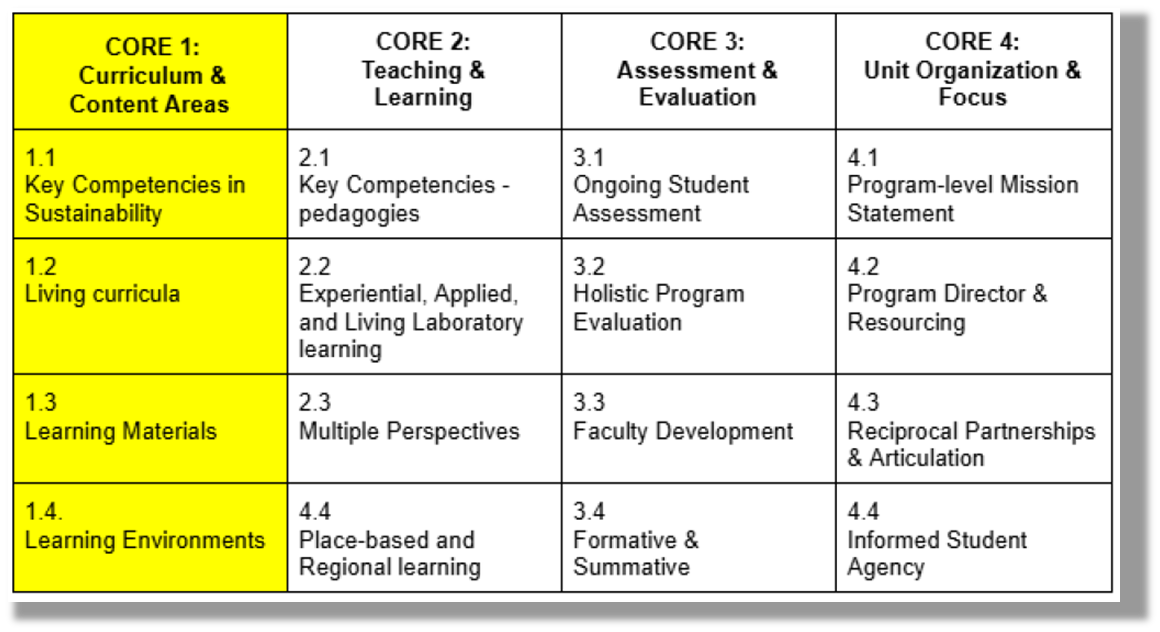
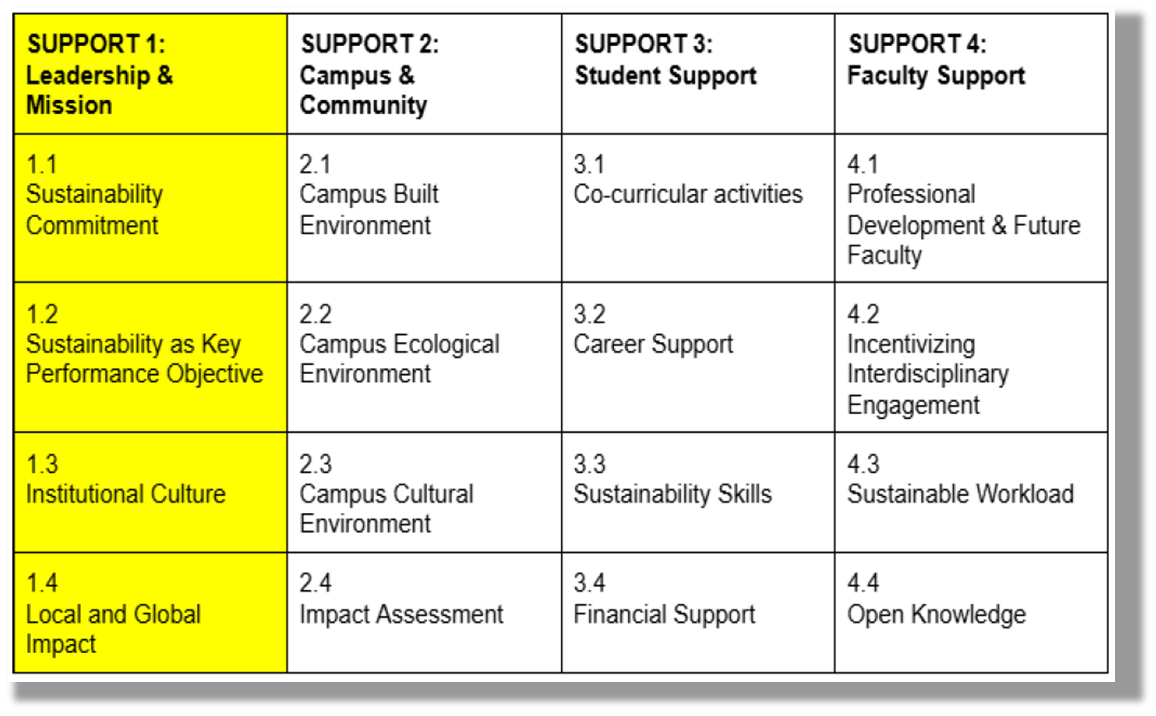
Developed with input from over 500 stakeholders and organizations like the NSF and AASHE, the guidelines outline good practice across eight critical areas, emphasizing in addition the important Key Competencies in Sustainability Framework. Here’s a quick glance of SEAC’s 32 quality assurance standards, structured into Core and Support categories.
Creating “Ready-to-Use” Narratives for Documenting TASK™ and SEAC Alignment
What we have done at Sulitest as one of the foundations of our partnership with SEAC is to identify areas of potential alignment between SEAC accreditation standards, on the one hand, and the assessment data and processes generated by Sulitest TASK™, on the other. To do this, we analysed each SEAC standard—both what is textually stated and what evidence SEAC recommends institutions should provide to demonstrate compliance. In this process, Sulitest identified 6 SEAC Standards for which the use of TASK™ in the Change Leader program provides “Substantive” evidence, another 14 SEAC Standards providing “Contributory” evidence, and 12 SEAC Standards where the TASK™ framework is not applicable.
In short, Sulitest identified areas of alignment across 20 of SEAC 32 standards, both Core and Support. Moreover, this effort to align SEAC and TASK™ quality assurance frameworks resulted in a one-page overview (see below) and corresponding bank of eight alignment charts, one for each main standard. You can view the full 9-page compendium of SEAC-TASK™ alignment charts here.
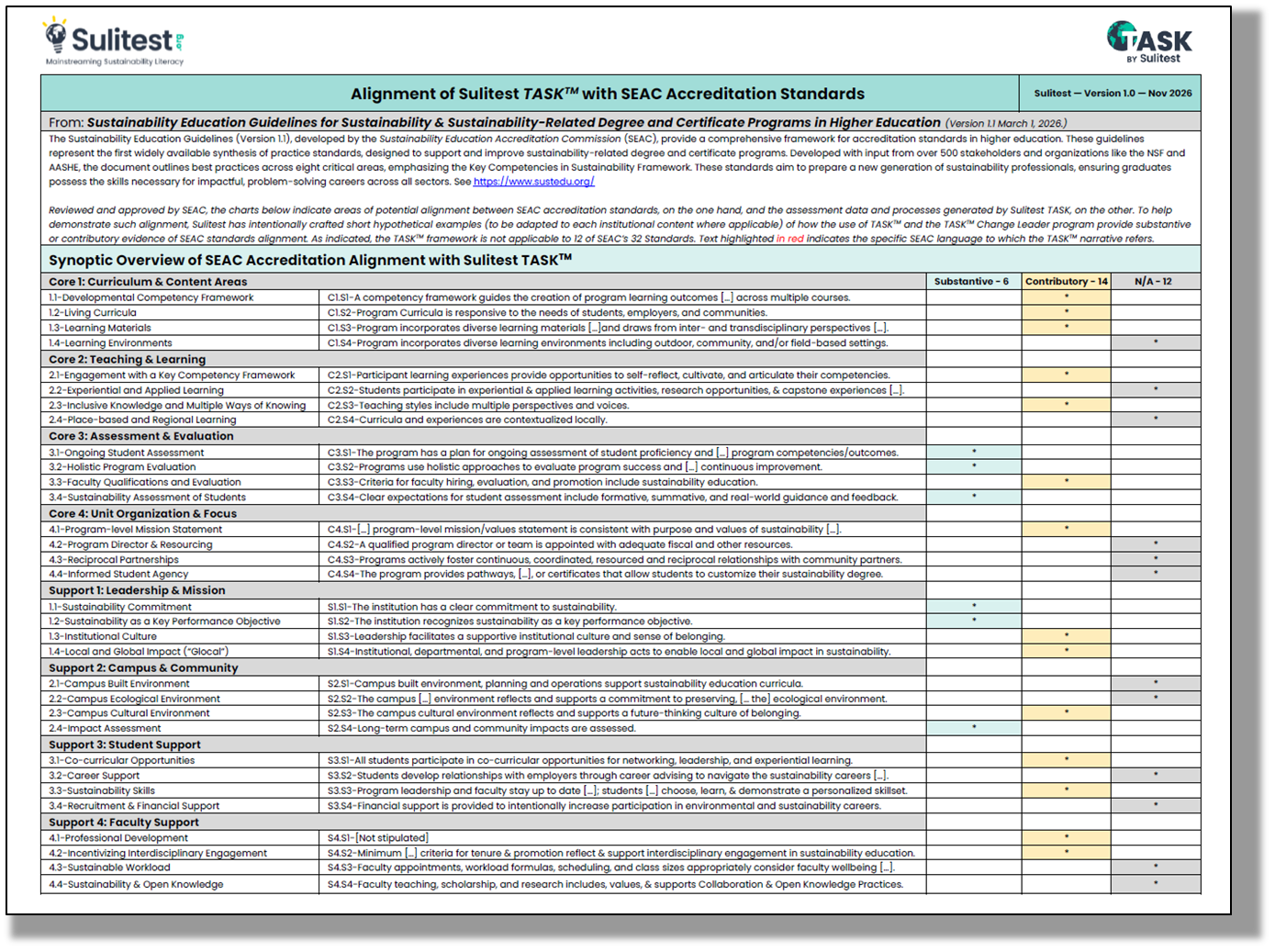
As you’ll see when you look at the full bank of alignment charts, and to help demonstrate alignment with Core and Support SEAC Standards, Sulitest also intentionally crafted short hypothetical examples (to be adapted to each institutional context where applicable) of how the use of TASK™ and the TASK™ Change Leader program provide substantive or contributory evidence of SEAC Standards alignment. Institutions using TASK™ are invited to use, adapt, and integrate these “stock” texts into the self-study narratives of their accreditation reports. And while the examples cited below relate specifically to SEAC accreditation standards, you’ll quickly see that they can just as well be applied to other accreditation agency’s reporting requirements, such as those of AACSB, AMBA, or EQUIS.
What SEAC Leadership Says About Alignment Between SEAC Guidelines and TASK™
When SEAC President Krista Hiser reviewed the full bank of alignment charts, she had this to say:
“The key area, to me, of course, is the Assessment and Evaluation Core 3 Standards. In particular, the "developmental" aspect (pre and post testing) and the "holistic" aspects of formative/summative assessments. That said, it’s very interesting to see the other areas of overlap and think about how Sulitest/TASK™ could meet multiple areas and be a useful tool and piece of evidence.”
Indeed, given the extensive landscape of sustainability knowledge described by the TASK™ model and matrix, the robust and disaggregated data that TASK™ generates across 28 discrete subjects, and the considerable commitment to sustainability education that the Change Leader program involves, it’s not surprising that TASK™ generates data, insights, and evidence that are pertinent and applicable to a wide range of accreditation and quality assurance concerns in higher education. TASK™ doesn’t do everything, but it does a lot more than you might think. Let’s take a look.
Areas of Expected Alignment — Assessment and Evaluation
Let’s quickly dispense with those areas of good practice for which TASK™ is specifically designed—i.e., assessment. In SEAC Core Standard 3 called Assessment and Evaluation, the TASK™ framework reveals substantive alignment with standard 3.1—Ongoing Student Assessment, 3.2—Holistic Program Evaluation, and 3.4—Sustainability Assessment of Students.
For standard 3.1, for example, SEAC guidelines stipulate that, to demonstrate compliance, programs must show that “multiple methods, approaches, and tools are used to assess increasing student proficiency and evaluate collective program-level achievement of competencies and learning outcomes.” To help programs provide such evidence, Sulitest has crafted the following corresponding “stock” text that institutions can then adapt to their local setting and context:
As a standardized external psychometric test of knowledge, TASK™ is integrated into larger mixed-method strategies of student and program assessment. Pre and post data generated by TASK™ is comparable internally across courses, programs, and year-to-year cohorts. This data is benchmarked externally against discipline-based and global institutional averages. Data is filterable and may be disaggregated by subject, SDG, and type of knowledge. Similarly, and in terms of providing students with ongoing feedback, the TASK™ platform provides each student with a dashboard displaying both individual and cohort-based assessment scores and comparative benchmarks they can use to track their personal progress against other assessment metrics and subsequent deliveries of TASK™.
For standard 3.2 on Holistic Program Evaluation (as a second example), SEAC guidelines stipulate that, to demonstrate compliance, programs must have in place “multiple measures and methods providing frequent feedback loops for continued program improvement.” To help programs provide such evidence, Sulitest crafted this “stock” text that institutions, again, can adapt to their local contexts:
As a standardized external psychometric test of knowledge, TASK™ is integrated into larger mixed-method strategies of student and program assessment. Aggregate TASK™ assessment data also helps inform the process of annual curricular and program review, revision, and improvement. As such, TASK™ data constitutes robust and reliable feedback data.
For standard 3.4 on Sustainability Assessment of Students (as a third example), SEAC guidelines stipulate that, to demonstrate compliance, programs must provide “evidence of multiple forms of assessment” and that “student assessment include formative and summative components.” To help programs provide such evidence, Sulitest crafts the following “stock” text:
As an external standardized test of sustainability knowledge, TASK™ is a useful complement to internal assessment processes delivered at the course and programmatic levels. As a test of factual sustainability knowledge, TASK™ also complements self-reported assessment processes related to self-perceived attitudes and values. The flexibility of TASK™ allows it to be used for both formative and summative assessment processes. For example, at the start of each program, formative assessment is instituted when students discover the TASK™ matrix of sustainability knowledge, explore Intro2TASK learning resources, take TASK™, and then review TASK™ Study Guides. At the end of the year or program, TASK™ is delivered as a summative assessment in which pre- and post-scores are compared.
Finally, in SEAC Support Standard 2 called Impact Assessment, the TASK™ framework reveals substantive alignment with standard 2.4—Long-term campus and community impacts are assessed. Again, SEAC guidelines stipulate that to demonstrate compliance, programs must “measure what matters” and demonstrate that the “campus/program has a strategy and plan for measuring one or more local impacts.” To help programs provide such evidence, Sulitest has crafted the following corresponding “stock” text:
While TASK™ is designed to assess only knowledge of sustainability principles, issues, and potential solutions, such a measure does have utility to local communities when used as a complement to local impact assessment processes. Moreover, when TASK™ is extended to community stakeholders, it generates standardized data that institutional and community leaders can use to inform local impact-focused strategies.
These four examples of substantive alignment between SEAC Guidelines and the TASK™ framework provide compelling evidence that in key areas of assessment and evaluation vis-à-vis ongoing assessment, program evaluation, continuous improvement, sustainability knowledge assessment, and societal impact, using TAS™ and TASK™ data, and joining the Sulitest Change Leader program significantly facilitates the process of demonstrating and documenting fulfilment of core and support accreditation standards. Accreditation reporting processes are always time-consuming, costly, and a lot of work. But using TASK™ and joining the Change Leader program certainly lightens the load.
Areas of Unexpected Alignment — Leadership & Mission
Let’s now look at several areas of accreditation reporting beyond assessment and evaluation where TASK™ is also quite useful. Indeed, you might be surprised at how TASK™ and the Change Leader program generate evidence and a narrative of substantive compliance even in areas of quality assurance unrelated to student learning and assessment.
Let’s consider, for example, two SEAC Standards presented under Support 1-Leadership and Mission. We look first at Standard S1.S1. on Sustainability Commitment that states “The Institution has a clear commitment to sustainability.” To clarify what such a commitment looks like, SEAC provides this explanation and corresponding examples:
Evidence suggests that effective administrative leadership fosters alignment across departments in terms of messaging and the focus of institutional sustainability efforts. Roles, goals, and measurement are supported across multiple stakeholder groups, including the local community and region, academic departments, operations, and research. Markers matter, such as the President's Climate Leadership Commitments Statement, AASHE STARS, and/or Carnegie Elective Classifications.
Moreover, in terms of the evidence SEAC recommends institutions provide to demonstrate compliance to S1, the SEAC guidelines specify the following examples:
- Sustainability education […] is central to college/school strategic planning and has clearly articulated metrics and accountability.
- Academic programs for sustainability have campus-level oversight, and the program is interdisciplinary (more than one academic unit is engaged).
- Meaningful and visible commitments to sustainability are made through participation in one or more sustainability or sustainability-related organizations, credentials, ratings, or memberships.
To help programs provide such evidence, Sulitest crafts the following “stock” text, again to be adapted to institutional contexts:
Launched in 2023, the TASK™ assessment tool and corresponding Change Leader program together have become an important marker of institutional commitment to sustainability teaching and learning. Requiring as it does: a) a three-year commitment to deploy TASK™ across a majority of students; b) a non-negligeable subscription cost to gain access to TASK™ tools and resources and; c) administrative, staff, and IT engagement in integrating TASK™ into annual assessment processes—together indicate a substantial and ongoing institutional commitment to sustainability. The very act of partnering with Sulitest in the TASK™ Change Leader program constitutes a significant and substantive effort to embed sustainability into programming, assessment, and curricular review.
We look next at SEAC Standard S1.S2 on Sustainability as a Key Performance Objective that states “The institution recognizes sustainability as a key performance objective.” To clarify what this means, SEAC provides this description of the desired evidence:
Evidence shows that sustainability education […] is included in the institution’s long-term performance goals and strategic planning [vis-à-vis strategic planning, operations budgeting, research, academic programming, non-credit offerings …]
Again, to help programs provide such evidence, Sulitest crafts the following “stock” narrative:
As stated above, TASK™ and the TASK™ Change Leader program require strategic institutional and programmatic leadership support, resource budgeting and allocation, and a commitment to curricular review and revision (as part of academic programming). Moreover, TASK™ succeeds best when corresponding support, training, and professional development for the faculty have been designed and instituted around educating for sustainability. Finally, the considerable data TASK™ generates provides faculty members with multiple opportunities to engage in institutional research focused on teaching and learning processes and outcomes vis-à-vis sustainability on campus. The design and deployment of TASK™ is premised upon making sustainability a key performance objective within HEIs. As a non-credit initiative that supports life-long and continuous learning processes, the TASK™ Change Leader program also allows the program to assess the sustainability knowledge of the program’s alumni cohorts on an annual basis, thus providing richer longitudinal data.
If it’s Evidence You Need for Standards Compliance Reporting, Your TASK™ Is Now Much Easier
These six examples alone attest to the value of TASK™ and the TASK™ Change Leader program in terms of generating data and insights that are pertinent to institutions engaging in accreditation reporting, quality assurance, and demonstrated continuous improvement. And do recall that these six examples correspond only to SEAC Standards where TASK™ provides Substantive evidence of alignment to accreditation standards. The eight alignment charts highlight an additional 14 examples where TASK™ provides Contributory evidence of alignment. Moreover, depending on institutional experience and innovative use, there are no doubt more examples of how TASK™ can be articulated in ways that generate evidence of compliance to accreditation standards.
And while it’s true that TASK™, the TASK™ Change Leader program, and the SEAC accreditation standards (not to mention Sulitest and SEAC) are naturally aligned allies in advancing sustainability education — why wouldn’t there be close alignment! — it is instructive to reflect upon what henceforth constitutes good practice in assessment, accreditation, and quality assurance in the coming Anthropocene world. This short essay provides some tentative answers to that question.
In the end, what’s important is that sustainability teaching and learning across the curriculum result in transformation change in human behaviors and values. This must urgently become the new ethos and outcome of higher education across the planet.
Although with different tools and processes, SEAC and Sulitest are fully committed to—and aligned on—this vision. The more we work together designing, delivering, and demonstrating quality sustainability education, the more we might deserve an accreditation—such as SEAC supported with Sulitest TASK™ data—that really matters.



Stay in the loop!
Are you interested in sustainability education, the latest news from our movement, or key events in the sector?
