


Socratic Method as Transformative Pedagogy — The Expeditus Dialogue on Quality Education
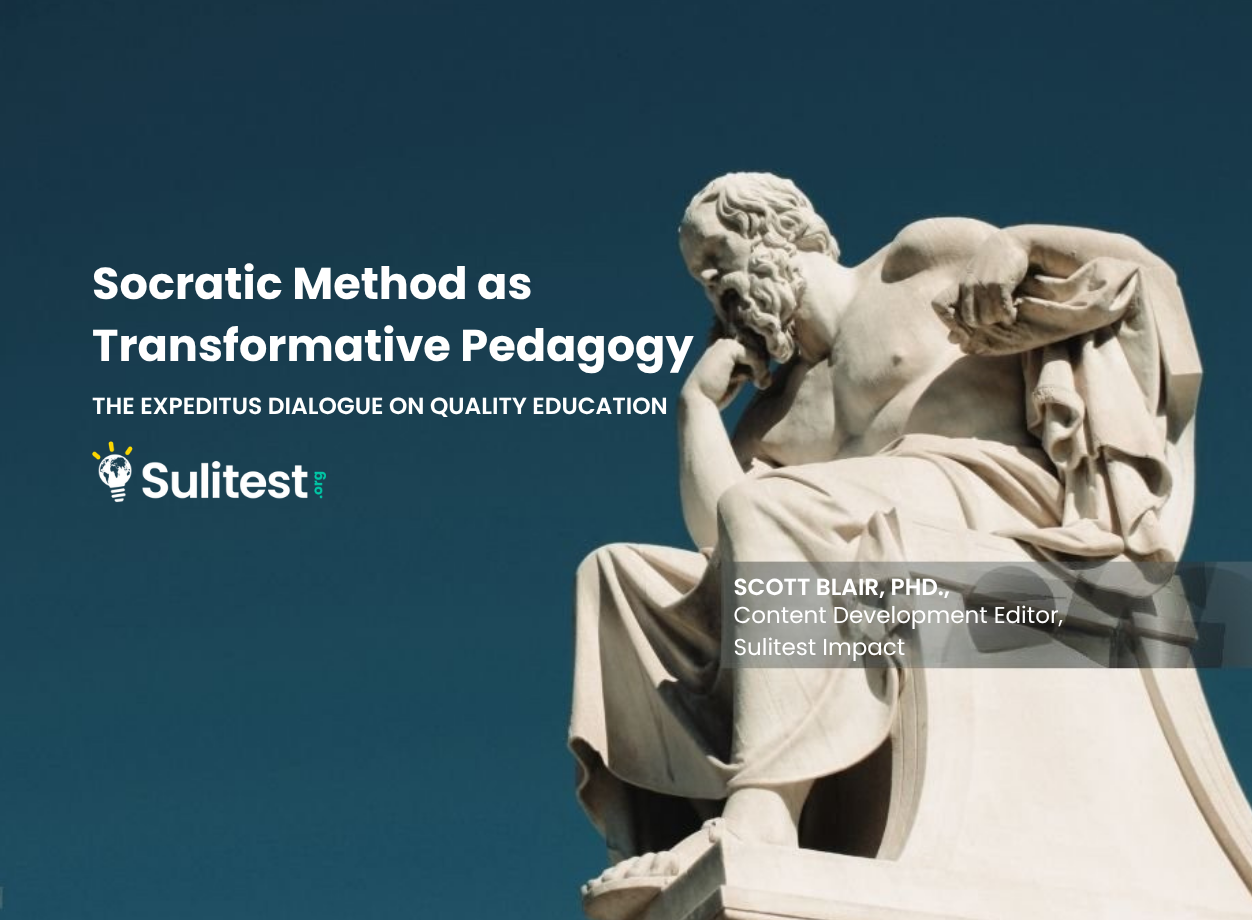
Scott Blair, PhD., Content Development Editor, Sulitest Impact
Introduction
It is my unconfirmed contention that, in the end, climate disruption, collapsing biodiversity, and deepening social injustice are the inevitable result of the false assumptions, fallacious thinking, and faulty logic of most humans across history, including me. Too few of us elect to subject our beliefs, values, and behaviors to external evaluation, skeptical criticism, cross-examination, forensic investigation, or even nagging doubt. Wishing to hide rather than face our cognitive deficiencies, confirmation biases, and logical inconsistencies, we shun the hard mental and emotional work of interrogating our assumptions, questioning our values, and critiquing our behaviors. Out of fear, prejudice, self-satisfaction, distraction, and laziness, we build an image of the world (and imagine our place within it) without consideration of any rules of evidence, logical refutation, formal proof theory, or rigorous validation. The world we blithely imagine to be real—but is not—reveals just how little awareness and self-awareness we choose to internalize. Given the mess we have made of our planetary home, what we really need now is to start examining our lives, to start seeking deeper truths about our unsustainable behaviors, and to start asking how we ought to live ethically here on Earth, as the temporary residents we are.
And this is why the Socratic Method of teaching and learning holds out so much promise in the context of education for sustainability. The goal of Socrates was never ontologically to teach his pupils more facts or impart more knowledge about the world—it was to help them epistemologically grasp how knowledge is created, constructed, and validated. With this inductive approach to reasoning, he sought to nudge his students towards seeing the world not as they believed it to be, but as it really is, i.e., one of complexity, difficulty, ambiguity, mystery, and uncertainty. His goal was to help them see and accept how little they knew about the world, to learn to doubt and question their tightly-held but erroneous beliefs and certainties about it, and to grow wise via skepticism and by exercising their otherwise neglected powers of ethical and logical reasoning while acknowledging their deficiencies and repressed prejudices.
And this is why the Socratic Method is such a transformative pedagogy. It is premised upon challenging and deconstructing the many ways we falsely imagine the world to be, so as to begin seeing it differently, i.e., as it is—stunningly beautiful, extremely rare, precious to all, unfathomably complex, systemically integrated, delicately balanced and fragile, and robust and resilient, yet eventually breakable if subjected to too much abuse. Indeed, the Socratic Method is one of the few pedagogical pathways left to us able to lead students towards a true environmental understanding of what constitutes the good life here on planet Earth—i.e., one that is genuinely sustainable in all its ethical and material ramifications.
“Know thyself,” says Socrates, which in the context of today’s Earth crisis is pertinent only if understood as a Socratic injunction to understand one’s place within Nature—i.e., not outside it, not above it, not holding dominion over it. Moreover, that “an unexamined life is not worth living” as Socrates intoned back in 5th century Athens, surely means to us today—in the midst of a full-blown planetary crisis—that should we elect to continue down our pathway of unexamined lives, it’s not that life won’t be worth living; it’s that life won’t be able to be lived at all, as least not as we know it since the start of the human-friendly Holocene epoch. In short, it’s too late now for knowledge alone to save us. It’s wisdom that’s needed. And it may be only Socrates with his crazy, disruptive, and maddening Q&A method that helps us get closer to such understanding, awareness, and universal wisdom—because his pedagogy is designed to help us see ourselves in the world more truthfully.
In this spirit, I share with you two short pieces about the Socratic Method as it applies to education for sustainability. First, I provide renewed access to my 5-page overview of the pedagogy of Socrates that I embedded in the 2024 PRME—Sulitest White Paper entitled “Situating PRME’s Impactful Five (i5) in the Landscape of Higher Education Pedagogy — Bridging Theories, Principles, and Practices.” (Click here to access the full report and then scroll down to page 28.)
Second, I have written below a whimsical philosophical dialogue between the “gadfly of Athens” and the quasi-fictional Expeditus in which, via debate and inductive reasoning, Socrates and his “student” seek deeper truths about the nature of quality education. If you’re able to get through this, my hope is that you’ll come away seeing the potential of the Socratic Method as a truly transformative pedagogy and appreciate its relevance within the context of educating for sustainability.
As Socrates might say today, were he facing our planetary crisis: To know thyself, know the world.
The Expeditus Dialogue — A Conjured Example of the Socratic Method
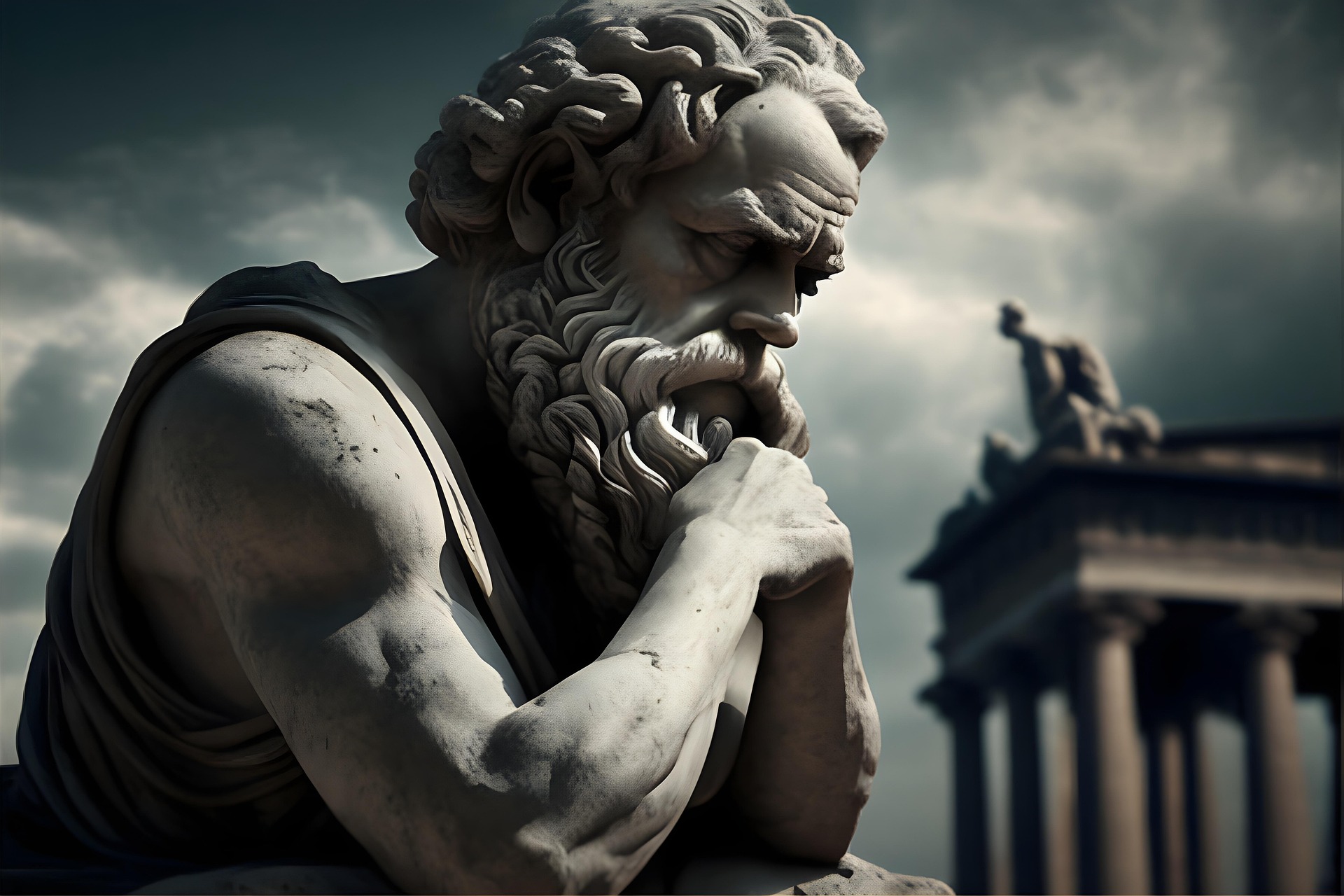
Expeditus: Greetings to you today, Socrates.
Socrates: Greetings to you, young Expeditus. I see you’re off to another day of teaching at the academy.
Expeditus: Indeed, it’s important that our youth get a quality education. Do you not you agree, Socrates?
Socrates: I most certainly do. And is this what you are providing at your academy—a quality education?
Expeditus: Indeed, it is my belief that it is.
Socrates: Excellent. So, then I ask you: what is a quality education?
Expeditus: An important question. A quality education is one that allows a person to prosper in life.
Socrates: Quite so. And “to prosper,” you mean “to accumulate enough wealth to live in dignity?”
Expeditus: That is correct and I like your turn of phrase.
Socrates: We shall see. In any event, if I understand correctly, you are saying that a quality education is one that allows you to prosper in life by working, accumulating wealth, and living a life of dignity.
Expeditus: That is what I am saying. You understand correctly.
Socrates: And will some people define dignity differently and want to accumulate more wealth than they really need or can use?
Expeditus: History indicates that this is undoubtedly true.
Socrates: So, this will lead to some people accumulating a great deal of wealth and others accumulating very little?
Expeditus: Assuredly. This is what we see today, even here in enlightened and democratic Athens.
Socrates: And might this disparity create tensions between those who have a lot and those who have a little?
Expeditus: It is, alas, very likely.
Socrates: And is it not just as likely that the process of accumulating such wealth will degrade the land, sully the water, and destroy the kingdom of animals? Might such “prosperity” make it hard to live a life of dignity, both for the individual citizen and the collective polis?
Expeditus: Based on what you say, Socrates, it would seem so.
Socrates: So, do you agree that teaching and learning that leads to social inequality and environmental degradation is not one that we should characterize as a “quality education”?
Expeditus: I see that I must agree with you, Socrates. So, let me rephrase my original statement and affirm that a quality education is one that allows a person to live a simple life of dignity—one no more ostentatious than, say, that of the average citizen of Athens.
Socrates: Excellent. We are making progress and becoming wiser. Such is the power of ethical reasoning.
Expeditus: I look forward to seeing where this line of thinking takes us.
Socrates: Have patience, my good friend. This is an open-ended process of question and answer. Indeed, in this spirit, when you say, “average citizen of Athens”, is it not true that while these average citizens do indeed live modest and humble lives compared to our wealthier citizens here in the Athenian polis, they live lives far more affluent and accumulate far greater wealth than the average citizen of, say, Macedonia, Thrace, Scythia, and Persia?
Expeditus: I cannot disagree. Athens is a city of wealth, prosperity, and achievement to be admired by all.
Socrates: Perhaps. But ask yourself if there are enough resources in Greece to raise everyone to the level of prosperity achieved here in Athens. Then ask yourself if there are enough resources on all of Earth to raise everyone to the level of prosperity achieved here in Greece. Might it be quite possible that even the humble lifestyle of the average unassuming Athenian is unsustainable when scaled to the entire planet that our venerable Pythagoras tells us is round and quite big?
Expeditus: It does seem to be possible.
Socrates: Isn’t it also true that we want these non-Greek speaking peoples onomatopoetically referred to as “barbarians” to share our concerns about social inequality and the dangers of biosphere decline even though their sandal-print on the land is much smaller than that of the average Greek, not to mention Athenian?
Expeditus: This is undeniably true.
Socrates: It also seems to me, with what little I know about planetary boundaries, that the material living standards of the non-Greek world cannot be raised to average Athenian living standards without degrading and destabilizing the natural world so well described by Thales, Anaximander, and our beloved animal-rights activist Empedocles.
Expeditus: I fear I must agree, although I do think Thales had a bit of water on the brain.
Socrates: That’s another matter. But as concerns us here in this debate, I would bet no more than four drachmas that the Athenian populace would countenance a drop in living standards equal to, say, our Peloponnesian neighbors, the Spartans, much less the far-away Trojans or very scary Scythians.
Expeditus: That is a wise wager. And as for me, I suspect, I’d even keep my “Owl” in my pocket.
Socrates: Indeed. How prudent of you. So, you see, Expeditus, I find I am no closer than before to understanding what constitutes quality in the education you provide the young at your academy. You state it’s all about achieving modest prosperity, humble lifestyles, and simple dignity. Yet you are now agreeing with me that, if using Athens as a reference point, such “reasonable” lifestyles are neither sustainable locally nor scalable globally.
Expeditus: I concede that this must be true.
Socrates: Moreover, it seems to me that the way you articulate the learning and programmatic outcomes at your academy inevitably creates the very social and environmental conditions that an otherwise quality education would be working to highlight and remedy. Is this not so?
Expeditus: I am unable to find fault in your logic. I am at an impasse and now wonder what really constitutes a quality education. I admit that I feel a sense of real puzzlement.
Socrates: Be not alarmed, Expeditus. I get this a lot. You are suffering from a mild case of Aporia—a state of confusion, discomfort or puzzlement when a person realizes they don’t know what they previously thought they did know. Your condition will get worse until you start examining your life and begin questioning your pedagogical assumptions more deeply. The only true wisdom is in knowing how little you know.
Expeditus: So, to clear away my false beliefs and unexamined certainties, I will start over and try again to answer your question: what is a quality education.
Socrates: Excellent, Expeditus. Strive to know thyself and do reiterate your position. The productive discomfort you feel and your admission that you know very little about quality education indicates that you are becoming wiser. I encourage you to examine your life more deeply. I promise you it will be worth it.
Expeditus: So, based upon the inconsistencies, faulty logic, and fallacies of my position that you have so maddeningly pointed out, and despite all the stress of debating with you Socrates, I will hazard that a quality education is one that gives learners knowledge of how the natural world works, cultivates love and reverence for its beauty and rarity, reveals our appropriate place within it and dependence upon it, and fosters wisdom and behavioral agency to protect and preserve it for future generations of all Earth’s fellow travelers. What do you think of this definition of quality education, Socrates?
Socrates: Well, I am ignorant of many things, but it seems to me that this is a good starting point for helping learners think about their underlying values, beliefs, assumptions, and principles. Is it not true that moral education is essential if students are to grapple with the complexities, difficulties, uncertainties, and trade-offs of the world around us?
Expeditus: It is true as you state. With your inductive reasoning and iterative questioning, Socrates, you have helped me reveal hidden yet universal truths about the nature of quality in education. I am grateful to you, if a little miffed.
Socrates: I am glad to help as I am but a humble seeker of knowledge. But I affirm that an unexamined curriculum is not worth teaching.
Expeditus: This too is true.
Socrates: And what about pedagogy, my dear fellow? Should we not devise a special ecopedagogical method of teaching and learning that corresponds to the high ideals of your academy’s new learning objectives?
Expeditus: Indeed, we should.
Socrates: And might we call it something snappy, easy-to-remember, and as a testament to our happy and enlightening dialogue?
Expeditus: Indeed, we might. We can call it … The Expeditus Method.
Socrates: I despair! Give me a cup of herbal tea! Anything of the flowering nitrophile plant species will do.

Our latest articles

Stay in the loop!
Are you interested in sustainability education, the latest news from our movement, or key events in the sector?
