


Mission unsustainable: Turning problems upside down at the 2026 BSIS & Sulitest Reverse Brainstorming Workshop
On 10 March 2026, members of the EFMD/BSIS and Sulitest communities gathered online for an interactive session to explore how business schools can accelerate their positive societal and environmental impact. To consider this question, the workshop adopted an unconventional approach by examining the problem in reverse:
What if we deliberately tried to fail at sustainability and societal impact?
At first glance, the question might sound counterintuitive. Yet it proved to be the perfect starting point for a dynamic and interesting exchange between educators, institutional leaders, and sustainability practitioners from across the EFMD/BSIS and Sulitest networks.
Rather than focusing only on best practices or success stories, the session invited participants to examine the systemic barriers that often slow progress first.
The collaborative discussions showed how institutions might unintentionally undermine their own sustainability ambitions, and how these challenges, when identified first, could then be transformed into opportunities for meaningful change.
The result was an engaging and highly interactive session that combined reflection, creativity, and practical problem-solving.
The Reverse Brainstorming Methodology
The workshop was built around the reverse brainstorming methodology, introduced during the session by Jean-Christophe Carteron, Co-Founder of Sulitest. The approach is designed to challenge conventional ways of thinking by encouraging participants to examine problems from the opposite perspective. While traditional brainstorming asks to generate ideas that solve a problem, reverse brainstorming begins by asking the opposite question: how could we make the problem worse?
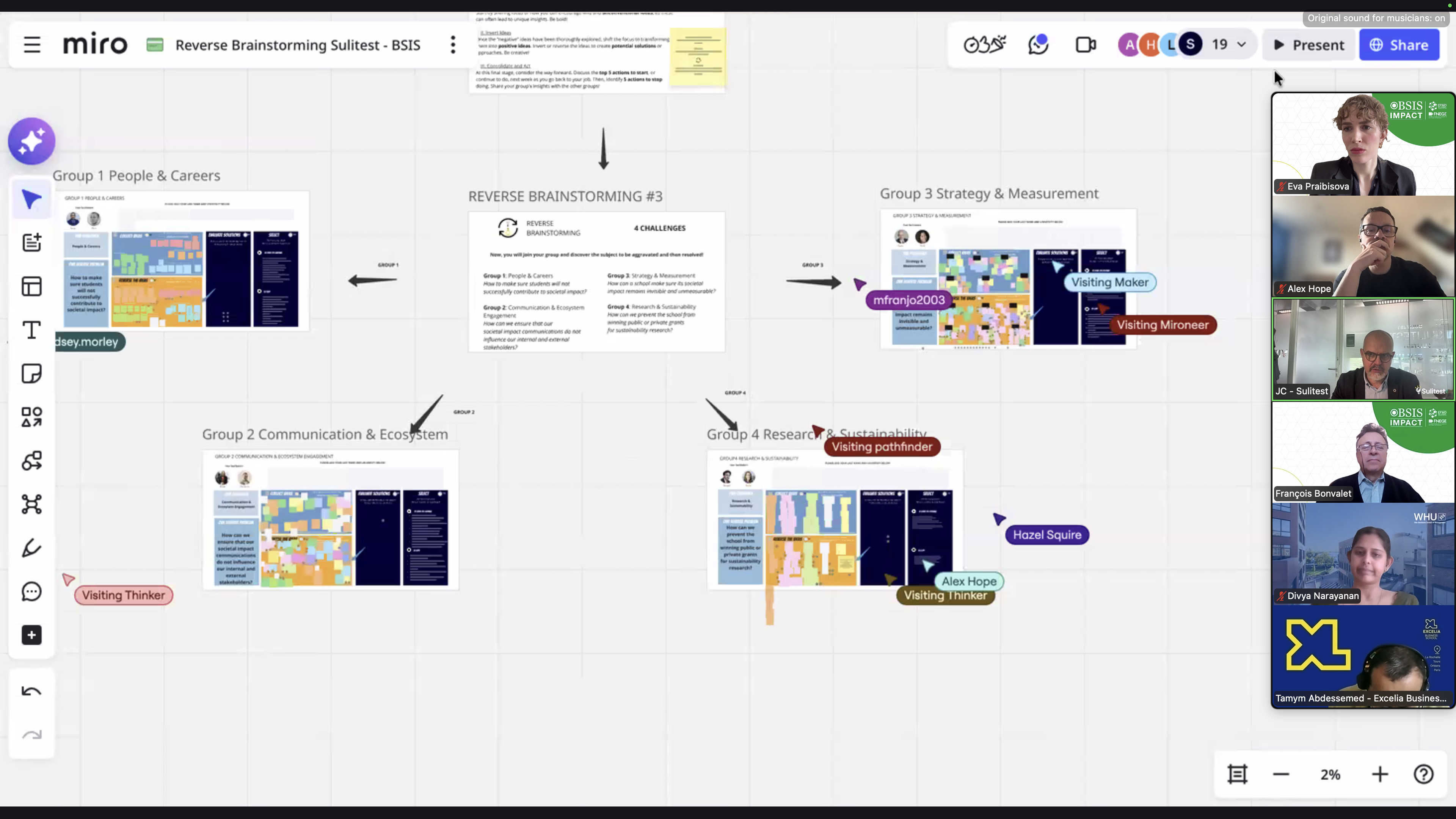
By imagining the most counterproductive actions possible, attendees were encouraged to uncover hidden assumptions and structural barriers. Once these “bad ideas” had been identified, the next step was to turn them around and develop constructive solutions.
This approach helps to move beyond surface-level discussions and often reveals insights that might otherwise remain hidden. As one facilitator noted during the workshop:
“When you start to work on what we should do in order to make it worse, you realise that many of those bad ideas are already in place.”
This realisation often sparks powerful conversations. By confronting uncomfortable truths, participants can identify concrete actions institutions can take to advance their impact and sustainability journeys.
Four challenges for higher education
The participants were divided into four breakout groups, each focusing on a specific theme for discussion. The themes included:
- People & careers
- Communication & ecosystem engagement
- Strategy & measurement
- Research & sustainability
Each group, led by an experienced facilitator and co-facilitator, explored how institutions could unintentionally weaken their impact in these areas through a reverse question.
Participants were encouraged to generate “failure scenarios”, imagining what actions or behaviours might prevent institutions from effectively integrating sustainability. Once these ideas had been collected, the groups worked together to reverse them and identify practical solutions.
This structure allowed them to examine complex challenges from new angles and to draw on the collective experience of the group.
Embedding sustainability across the student experience
The first discussion theme addressed the role of education in preparing students to contribute to societal and environmental impact. Facilitated by Tamym Abdessemed, Director and Dean of Excelia Business School and Deputy General Director of Excelia for Higher Education and Research, Strategy and Schools’ Development, together with co-facilitator Pierre Schulz, Account Manager at Sulitest, the group examined the reverse question:
“How can we make sure that students do not successfully contribute to societal impact?”
Starting from this deliberately provocative perspective allowed the discussion to surface several challenges that can limit meaningful student engagement with sustainability. These included a tendency to focus on theory rather than practical application, the repetition of sustainability content without clear progression, limited exposure to local or regional challenges, and insufficient recognition of student initiatives that contribute to societal impact.
Turning these ideas around revealed several clear priorities. A key takeaway was the need to embed concrete sustainability projects directly into the student experience and to encourage students to lead entrepreneurship initiatives addressing sustainability challenges, supported by mentoring and funding. The creation of sustainability councils and the explicit inclusion of sustainability and societal impact as learning objectives were also highlighted as important steps.
The discussion further emphasised the need for systematic faculty training and guidance to ensure sustainability perspectives are consistently integrated across programmes and research activities. Overall, the exchange reinforced the idea that preparing responsible leaders requires embedding sustainability throughout the student journey rather than treating it as a standalone subject.
Aligning communication with institutional reality
The second discussion theme focused on how institutions communicate their societal impact. This session was facilitated by Debra Leighton, BSIS Senior Advisor, accompanied by Constantin Baltès, Account Manager at Sulitest. Participants were invited to reflect on the reverse question:
“How can we ensure that our societal impact communications do not influence our internal and external stakeholders?”
Considering this question helped reveal several practices that can weaken the credibility and visibility of sustainability initiatives. Among the issues raised were overwhelming audiences with excessive information, communicating achievements without clear supporting evidence, relying on outdated communication channels, and operating in isolation without building partnerships with industry or other external stakeholders. It was also noted that overly technical research language can make sustainability initiatives difficult for broader audiences to understand.
When the exercise shifted to the “reverse” phase, attention turned to possible solutions. Several priorities emerged. Embedding societal impact communication within institutional strategy was identified as a key step, ensuring that messages are supported by clear evidence and measurable outcomes. The group also discussed the potential of tools such as societal impact dashboards and student assessment mechanisms to strengthen transparency and engagement and enhance students’ sustainability awareness.
In addition, another important takeaway was the role of incentives that encourage both students and faculty to engage in societal impact initiatives. Strengthening connections with regional ecosystems and developing strong local partnerships were also identified as important steps to enhance institutional credibility and extend impact beyond the campus.
Ultimately, the exchange underscored that effective communication is not simply about increasing visibility. When aligned with strategy and supported by credible evidence, it becomes a powerful mechanism for engaging stakeholders and demonstrating the tangible value of institutional impact. However, even the most compelling narrative requires robust evidence, making measurement a critical next step.
Measuring what truly matters
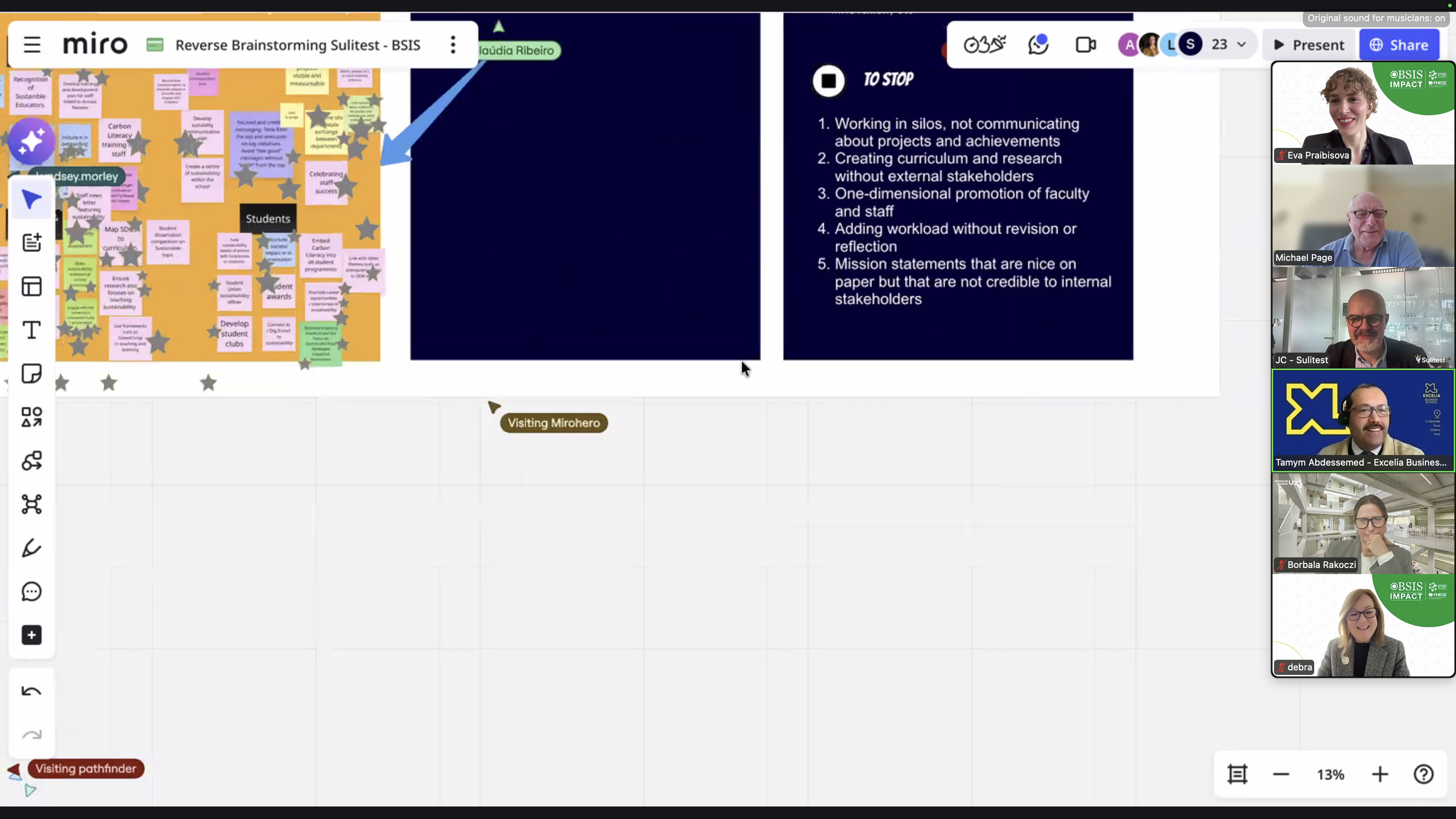
A third discussion theme examined the challenge of strategy and measurement of societal impact. The session was facilitated by Franjo Mlinarić, ESG Manager at Kozminski University and CEO of Kozminski Business Hub, together with co-facilitator Estela Castelli Florino Pilz, Project Development Manager at Sulitest. The group explored the reverse question:
“How can a school make sure its societal impact remains invisible and unmeasurable?”
This perspective prompted reflection on several organisational practices that can make impact difficult to track or demonstrate. Participants pointed to siloed working practices, limited communication about projects and achievements, and curricula or research initiatives developed without engagement from external stakeholders. The discussion also highlighted that mission statements may remain aspirational if they are not supported by concrete actions within the institution.
Reframing these issues brought forward a number of priorities. Embedding societal impact within the institution’s strategic narrative emerged as a crucial step, supported by adequate resources and a dedicated team. Developing clear key performance indicators (KPIs), establishing baseline measurements, and defining transparent and achievable goals were also identified as essential components of effective impact measurement.
In addition, strengthening staff and faculty training and building closer collaboration with external stakeholders such as NGOs, alumni, and industry partners were seen as important ways to ensure that societal impact becomes both visible and measurable across institutional activities.
Beyond measurement, the role of research in driving sustainability also emerged as key area of reflection.
Supporting sustainability research
The fourth discussion theme focused on the role of research in advancing sustainability and societal impact. Facilitated by François Bonvalet, BSIS Director, with Pauline Proboeuf, Researcher at Sulitest, serving as co-facilitator, the group considered the reverse question:
“How can we prevent the school from winning public or private grants for sustainability research?”
Approaching the issue from this angle highlighted several obstacles that can limit progress in sustainability-oriented research. These included the absence of a clearly defined sustainability research strategy, limited access to funding, insufficient incentives for researchers to engage in this field, and research cultures that remain strongly siloed.
Shifting the perspective allowed the group to focus on how these challenges can be addressed. Aligning research strategies with the Sustainable Development Goals (SDGs) emerged as a central recommendation, alongside the allocation of internal funding dedicated to sustainability research. Creating incentives for researchers and promoting interdisciplinary collaboration were also seen as essential steps in strengthening the institutional research ecosystem.
Organizing workshops and internal discussions to align staff around sustainability priorities and share relevant research outputs was likewise highlighted as a practical way to build momentum. At the same time, the group stressed the importance of moving away from practices that hinder progress, such as withholding funding for sustainability research, failing to incentivise engagement in this area, maintaining siloed research approaches, or limiting opportunities for collaboration and knowledge sharing.
Perspectives from Sulitest
During the workshop, a clear and consistent message emerged: sustainability can no longer remain fragmented, symbolic, or peripheral. It must be fully embedded, strategically aligned, and operationalised across the entire institution. This is essential for a business school, whose core mission is to educate the responsible leaders of tomorrow. Sustainability, therefore, cannot exist in isolation: it must be integrated into all dimensions of the school’s activities.
Across the different breakout sessions, remarkably similar ideas surfaced, which can be distilled into four key takeaways.
First, participants repeatedly pointed to the risks of siloed approaches, whether in teaching, research, communication, or strategy. When sustainability initiatives are disconnected or treated as standalone efforts, their impact becomes diluted and often goes unnoticed. Mapping these fragmented initiatives is therefore a critical first step toward building a more coherent and systemic integration of sustainability across the institution.
Second, there was a strong consensus on the need to move from theory to practice. In education, research, and institutional communication alike, sustainability only becomes meaningful when it is applied, measurable, and connected to real-world challenges and stakeholders. It is no longer a “nice-to-have,” nor can it be reduced to a single flagship initiative showcasing commitment. Instead, sustainability must be embedded within a comprehensive institutional approach to ensure consistency and long-term impact.
Third, credibility and transparency emerged as fundamental principles. Institutions must ensure alignment between what they say and what they do. This requires robust evidence, clear indicators, and tangible outcomes. Defining measurable objectives, assessment tools, and transparent reporting mechanisms is key to transitioning from isolated initiatives to a fully integrated sustainability strategy.
Finally, all groups emphasized the importance of engagement and incentives for students, faculty, and external partners. Meaningful transformation depends on empowering individuals, recognizing and rewarding initiatives, and fostering collaboration both within and beyond the institution. In this context, external stakeholders—including even competitors—can play a valuable role in shaping a coherent sustainability approach, enriching the learning journey, strengthening communication, and positioning the school within its broader ecosystem.
Final remarks
The reverse brainstorming methodology proved to be a powerful tool, not only for identifying practical actions to start or continue, but also for uncovering existing bad practices within specific institutional contexts. During this workshop, participants were able to openly highlight challenges and bad practices they had observed in their own organisations. Transforming these into impactful, positive practices is not always straightforward, especially when past decisions are deeply embedded and difficult to reverse.
At the same time, business schools operate within a rich and dynamic ecosystem, supported by partners, competitors, assessment tools, accreditations, and labels—a true toolbox to help navigate the complex journey toward sustainability and societal impact. Bringing together the BSIS and Sulitest communities in this workshop was therefore an opportunity to offer business schools a space to pause, reflect on their practices, and learn from one another.
Sulitest and BSIS would like to warmly thank all participants for their valuable insights, as well as the facilitators and co-facilitators for their guidance throughout the session. Bringing together two committed communities for a three-hour workshop was a powerful experience, and we hope participants gained as much from it as we did. One thing is clear: integrating sustainability and contributing to societal impact is not a solitary journey, but a collective endeavour, in which we all still have much to learn.
This article was co-written by the BSIS and Sulitest Teams. For additional insights, announcements and perspectives, please visit the EFMD Business School Impact System (BSIS). To explore the latest developments in sustainability, you can also consult the Sulitest news section.

Our latest articles

Stay in the loop!
Are you interested in sustainability education, the latest news from our movement, or key events in the sector?
