


EU GreenComp and TASK™: Seizing the Importance of Framework Alignment vis-à-vis Program Design, Learning Statements, and Knowledge Assessment
Here’s a sign that sustainability education is evolving in positive ways: more and more institutions are using formal competency-based frameworks to help articulate appropriate sustainability learning goals and programmatic outcomes. In fact, aligning one’s program to such frameworks is now considered by innovative and futures-thinking accreditation and quality assurance agencies, like SEAC (Sustainability Education Accreditation Commission), as a core standard of good practice for sustainability-related degree programs. Indeed, SEAC’s Core Standard 1.1 on Curriculum & Content makes this eminently clear: A competency framework guides the creation of program learning outcomes that students develop across multiple courses.
GreenComp – the European Sustainability Competence Framework is just the sort of framework that SEAC recommends for designing programs and articulating student sustainability competences and learning outcomes, while TASK™ – The Assessment of Sustainability Knowledge is a standardized, external, psychometric testing tool that provides program leaders with robust assessment data on the extent to which education programs in fact achieve their goals vis-à-vis building student sustainability knowledge and competencies.
To this end, Sulitest in mid-2026 updated its internal analysis of the alignment between the GreenComp framework and the TASK™ domain of sustainability knowledge as mapped out in the TASK™ matrix and corresponding bank of 28 Navigation Charts which were, in early 2026, also fully revised and updated. Like our previous report on GreenComp, this new analysis examines the connections between the two entities (GreenComp and TASK™) and highlights the extent to which TASK™ assesses the knowledge-related learning statements comprised within GreenComp.
What is GreenComp?
GreenComp is the European sustainability competence framework developed by the European Commission’s Joint Research Centre. It comprises 169 competence-based learning statements organized into four interrelated competence areas.
1. Embodying sustainability values
- Valuing sustainability
- Supporting fairness
- Promoting nature
2. Embracing complexity in sustainability
- Systems thinking
- Critical thinking
- Problem framing
3. Envisioning sustainable futures
- Futures literacy
- Adaptability
- Exploratory thinking
4. Acting for sustainability
- Political agency
- Collective action
- Individual initiative
GreenComp defines competence as a dynamic combination of knowledge, skills and attitudes. The framework can be effectively leveraged for curriculum review, the design of teacher education programs, assessment and quality assurance, certification, and general monitoring and evaluation of programmatic impact.
GreenComp and TASK™ — A shared foundation
GreenComp and TASK™ share a close common theoretical, scholarly, and research-based heritage.
They are both anchored in the Planetary Boundaries Framework, structured around the UN Sustainable Development Goals, and draw inspiration from UNESCO’s Education for Sustainable Development strategy. Both are also rooted in the research literature on key competences in sustainability.
They also share an embedded approach to sustainability, in which society and the economy are situated and dependent upon a planet of limited resources and clear ecological boundaries. Both articulate learning outcomes as a guide for determining curricular content and developing effective assessment processes.
How does TASK™ align with GreenComp?
GreenComp and TASK™ are complementary yet clearly distinct frameworks and tools.
GreenComp is composed of 169 competence-based learning statements, while TASK™ is a standardized assessment tool structured around 96 knowledge-based subjects. As such, the alignment between them should be considered indicative only. It all depends on how GreenComp and TASK™ are used within both program design and assessment processes.
However, and at face value, there is sufficient alignment in the language used to articulate learning statements and knowledge content in GreenComp and TASK™ to generate quantitative measures of alignment. Indeed, in our current analysis, the alignment statistics are generated by identifying GreenComp learning statements to which a corresponding TASK™ subject and topic can be matched, either explicitly or implicitly. By counting the number of TASK™ matches compared to the larger bank of GreenComp learning statements, a “mathematical relation” can be established. The percentages generated, however, should not be understood as representing a precise mathematical correlation between the two. Our analysis seeks only to indicate a general order of magnitude vis-à-vis content alignment between GreenComp and TASK™.
What does the alignment show?
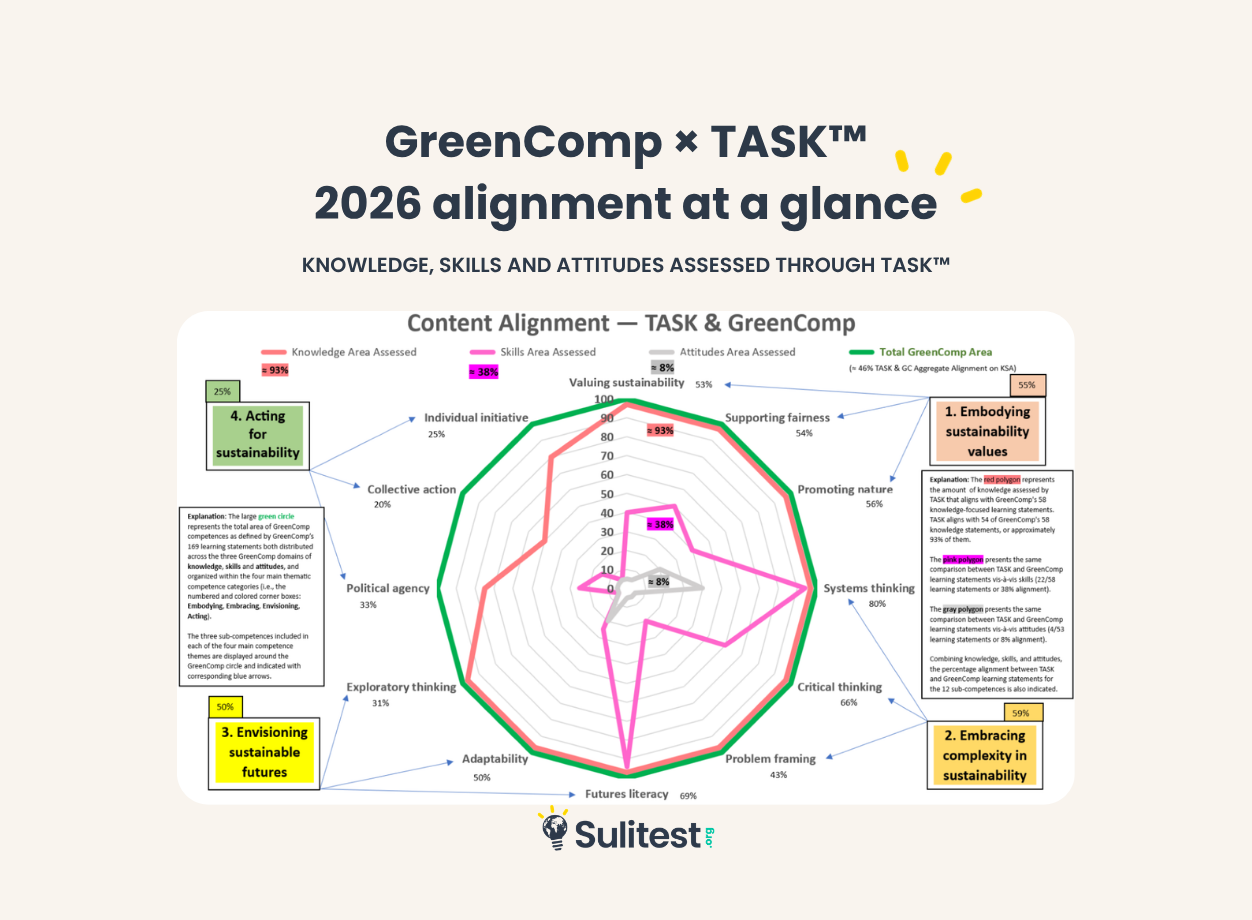
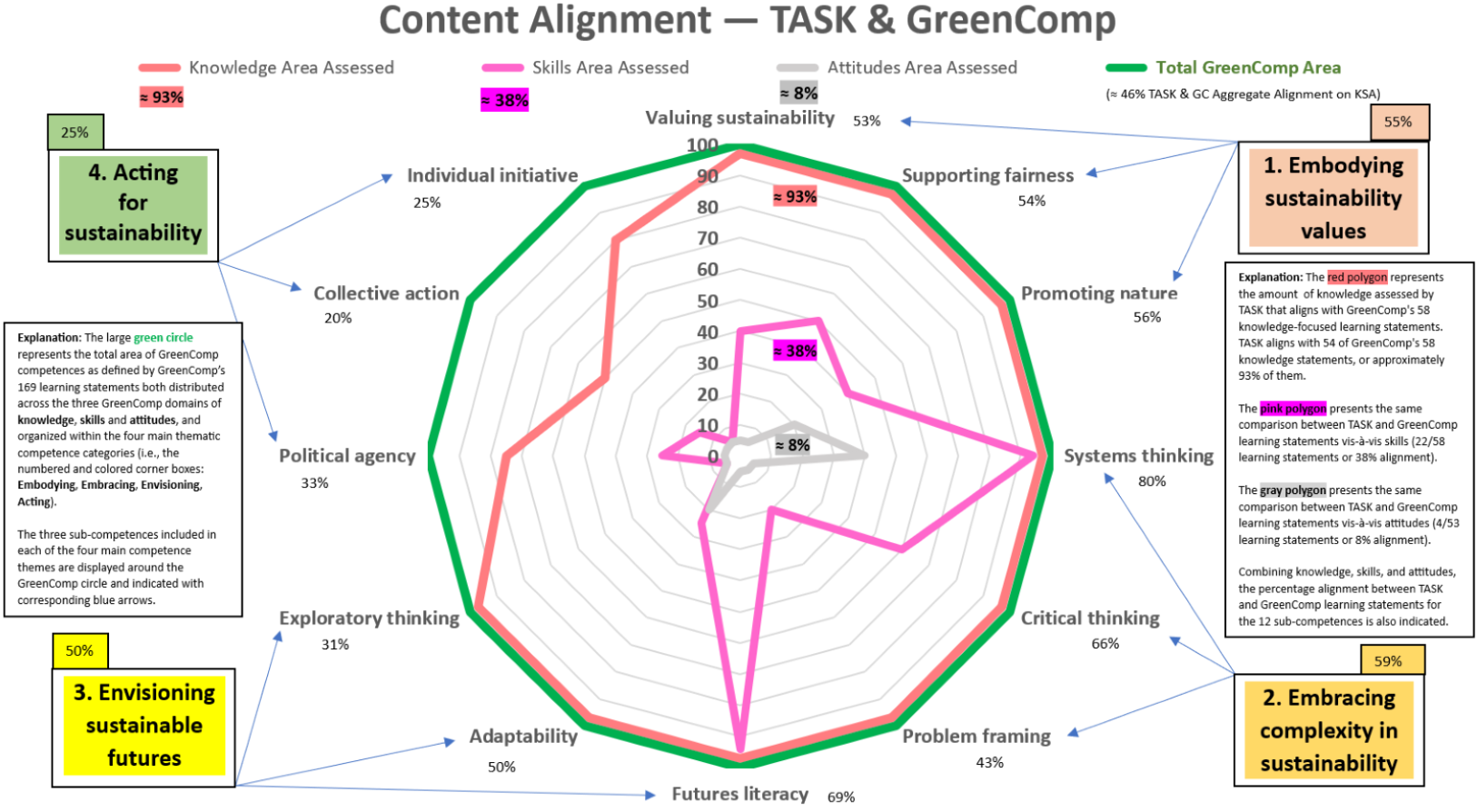
The 2026 analysis reveals a variety of alignment levels across GreenComp's dimensions of knowledge, skills, and attitudes:
- Approximately 90% of GreenComp's knowledge-related learning statements are assessed by TASK™.
- Approximately 40% of GreenComp's skills-related learning statements are assessed by TASK™ (via assessment of knowledge about skills).
- Approximately 10% of GreenComp's attitudes-related learning statements are assessed by TASK™ (via assessment of knowledge about attitudes)
- Overall, TASK™ assesses a little less than 50% of GreenComp's 169 learning statements.
These disparities reflect the different focus of the two approaches: GreenComp addresses sustainability competences through knowledge, skills and attitudes, while TASK™ focuses on assessing sustainability knowledge in isolation.
How was the alignment calculated?
To begin with, the new alignment charts compare the wording of GreenComp learning statements to content from the TASK™ matrix and 2026 version 2.0 of the Navigational Charts.
Next, to identify content alignment, Sulitest limited itself to analyzing GreenComp learning statements whose action or behavioral outcome could be meaningfully demonstrated through the multiple-choice-question format (MCQ) that is at the core of the TASK™ knowledge assessment process.
For example, verbs such as know, identify, articulate, and describe are appropriate descriptors for this type of MCQ assessment. Learning statements introduced by verbs such as cares about, is curious, is willing, is committed to, and wants to, were excluded from the analysis for the reason just stated.
As a result of applying this methodology, 88 of GreenComp's 169 learning statements were excluded from the analysis. For the remaining 81 learning statements, word-searches or “concept”-searches (using different wordings, synonyms, or terminological variations) was performed across the entire bank of 28 Navigation Charts to identify similar, associated, or often exactly the same knowledge content.
Why are the 2026 alignment statistics lower than in 2023?
You may note that the 2026 alignment statistics are indeed a bit lower than those from the 2023 analysis.
Three contributing factors account for this difference:
1. Stricter criteria for accepting GreenComp learning statement verbs
The 2026 analysis applies stricter criteria for determining which GreenComp learning statements can be effectively assessed through multiple-choice questions.
2. More granular definitions within TASK™ sustainability knowledge subjects
The 2026 TASK™ Navigational Charts provide a more strictly defined representation of sustainability knowledge.
3. A more extensive mapping of live TASK™ MCQs
The 2026 analysis includes a mapping of the current and much larger bank of live TASK™ MCQs that were not included in version 1.0 of the TASK™ NavCharts.
What does this mean for you and your institutions?
For institutions that have aligned their program learning goals to the GreenComp framework, the 2026 alignment charts provide more detailed and precise information on the extent to which TASK™ assesses the 12 competences of GreenComp. The 2026 alignment analysis also allows program leaders to see more easily, particularly for knowledge, clear alignment between quite specific subject content and MCQ testing processes specifically designed to assess that same knowledge content.
As stated above, TASK™ does not assess the full range of GreenComp competences. Rather, and where there is alignment, this analysis together with TASK™ Navigation Charts help identify useful connections, associations, and parallels between GreenComp learning statements and the sustainability knowledge assessed through TASK™. Knowing this is useful, particularly when you are designing program learning outcomes and key student competences that you intentionally want to be aligned to valid and reliable assessment tools and processes.
As the GreenComp framework itself notes, articulating learning statements, teaching content, and assessing outcomes together remains a qualitative process that instructors must adapt to their own discipline and institutional context.
The key message
If you've already aligned your program's learning goals to GreenComp, TASK™ has you well-covered for assessing your knowledge outcomes.
Learn more about TASK™
TASK™ provides a standardized assessment of sustainability knowledge based on a systemic approach to sustainability, enabling institutions to assess and monitor sustainability knowledge across educational programs.
Using GreenComp in your programme?
Explore how TASK™ can support the assessment of your sustainability knowledge outcomes.


Stay in the loop!
Are you interested in sustainability education, the latest news from our movement, or key events in the sector?
